


There’s a question that seems simple on the surface but gets more complicated the deeper you dig: where did the Irish actually come from?
Most people will say “the Celts.” And they’re right, partly. But the full story is messier, older, and far more interesting than the textbook version. The Celts in Ireland didn’t just show up one day and take over. Their arrival was a slow, layered process that unfolded over centuries, and its effects are still visible today in the Irish language, in place names, in mythology, and in the DNA of people living on the island.
So let’s unpack it properly.
Who were the Celts?

Before we get to Ireland specifically, it helps to understand who we’re actually talking about.
The Celts were not a single unified empire or nation. They were a collection of tribal peoples spread across a vast swath of Europe, linked by shared languages, artistic styles, and cultural practices. At their peak, Celtic-speaking peoples stretched from modern-day Turkey all the way to the Atlantic coast of Ireland and Spain.
What bound them together wasn’t a flag or a king. It was language, art, and a way of life.
The Celtic languages form a distinct branch of the Indo-European language family. Irish (Gaeilge), Welsh, Scottish Gaelic, Breton, Cornish, and the now-extinct Gaulish and Celtiberian all belong to this group. When linguists trace the roots of the Irish language back through time, they end up at a Proto-Celtic ancestor spoken somewhere in central Europe around 1000 BCE or earlier.
Two major archaeological cultures are closely associated with the early Celts:
- La Tène culture (c. 450 BCE–1st century CE): Emerged in Switzerland and the Rhine valley. Characterised by a striking, swirling artistic style that you’ll recognise from Celtic knotwork and metalwork. This is the culture most closely associated with the Celts, who influenced Ireland.
- Hallstatt culture (c. 800–450 BCE): Centred in what is now Austria, this Iron Age culture is considered the first distinctly Celtic archaeological horizon. Known for elaborate burial practices, iron technology, and trade networks.
How did the Celts arrive in Ireland?

Here’s where it gets genuinely fascinating, and where the old story starts to unravel.
For most of the 20th century, historians assumed the Celts arrived in Ireland through a large-scale invasion sometime around 500–300 BCE. Waves of Celtic warriors from Gaul or Britain swept across the island, displacing or absorbing the earlier population. It was a tidy narrative.
The problem is, the archaeological evidence doesn’t really support it.
There’s no clear layer of destruction, no sudden break in material culture that would signal a conquest. The La Tène artistic style does appear in Ireland from around the 3rd century BCE, but it emerges gradually, not all at once. And when we look at the genetic evidence, the picture gets even more nuanced.
What the DNA tells us
Ancient DNA studies carried out over the past decade have upended a lot of assumptions. Research published in journals like Nature has shown that the people living in Ireland during the Bronze Age (roughly 2500–500 BCE) were already a distinct population, descended from earlier Neolithic farmers and steppe migrants who arrived thousands of years before any “Celtic invasion.”
There is no sharp genetic break at the point where we’d expect a Celtic invasion to have happened. What we see instead is continuity, with the gradual addition of new genetic influences over time.
This has led many scholars to a different model: rather than a mass invasion, Celtic culture and language may have spread into Ireland through trade, elite exchange, intermarriage, and cultural prestige. Think of it less like a conquering army and more like the way English has spread across the world in the modern era, not always through force, but through influence, commerce, and cultural weight.
That said, some migration almost certainly happened. It’s unlikely that a new language family spread purely through cultural diffusion without any movement of people. The current thinking is that Celtic speakers came to Ireland in smaller waves, probably via Britain, over a long period beginning perhaps as early as 1000 BCE and continuing through the Iron Age.
The iron advantage: Why Celtic culture took hold
One thing that helped Celtic culture spread and take root was technology. Specifically, iron.
The transition from bronze to iron changed everything. Iron tools and weapons were harder and cheaper to produce (iron ore is far more abundant than tin or copper), and could be sharpened more effectively. Celtic smiths were masters of ironworking, and their swords, ploughshares, and tools gave Celtic-speaking communities a real material edge.
In Ireland, the adoption of iron technology from around 600 BCE onwards coincided with changes in settlement patterns and agricultural practices. Communities were able to clear more land, produce more food, and support larger populations. This is the kind of slow-motion transformation that doesn’t look dramatic in the archaeological record but completely reshapes a society over a few generations.
What the Celts brought to Ireland
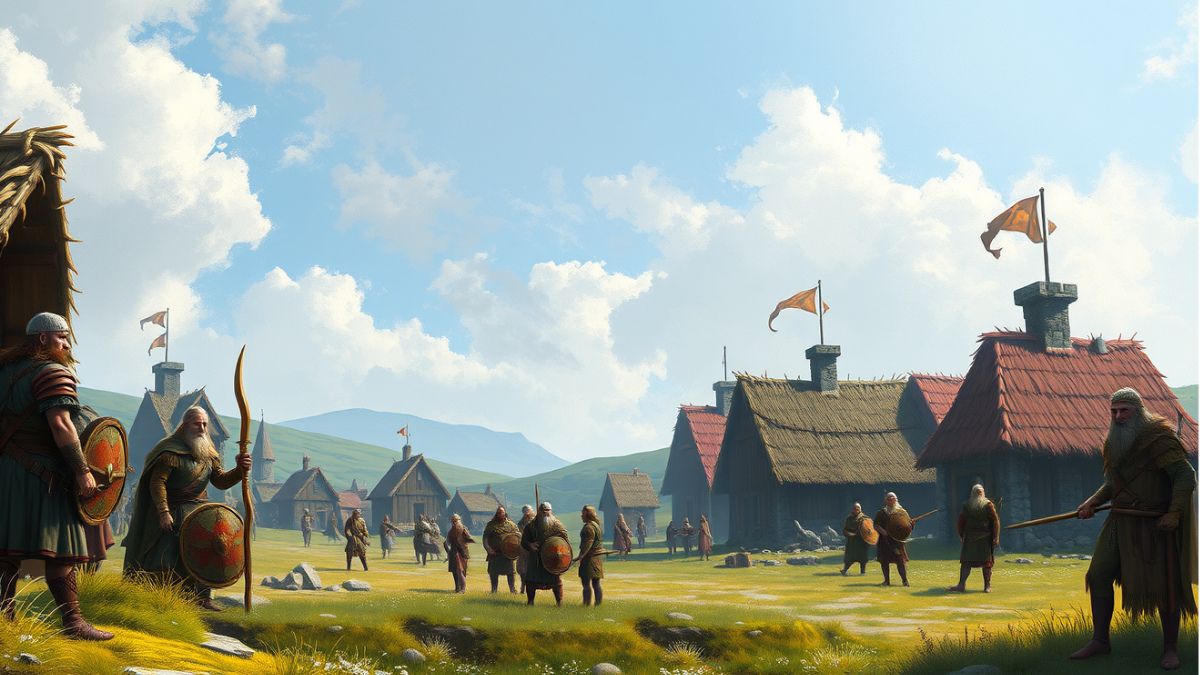
Regardless of exactly how they got there, the cultural contribution of the Celtic-speaking peoples to Ireland is enormous and long-lasting. Here’s a sense of what that looks like:
Language: Irish (Gaeilge) is one of the oldest written vernacular languages in Europe. Its ancestor was brought to Ireland by Celtic speakers, and despite centuries of pressure from Latin, Norse, Norman French, and English, it has survived. You hear it in place names across the island: Dún (fort), Inis (island), Gleann (valley).
Mythology and storytelling: The great cycles of Irish mythology, including the Ulster Cycle with figures like Cú Chulainn, and the Mythological Cycle featuring the Tuatha Dé Danann, are deeply Celtic in character. They share motifs with Welsh, Gaulish, and broader Indo-European traditions. The Irish literary tradition that preserved these stories is one of the richest in the ancient world.
Art: The La Tène style arrived in Ireland and flourished here in ways it didn’t survive elsewhere in Europe. The spiral and knotwork patterns you associate with “Celtic art” reached some of their highest expressions in Irish manuscripts and metalwork, most famously in the Book of Kells and pieces like the Tara Brooch.
Social structure: Celtic Ireland was organised around tuatha (tribal kingdoms), each led by a rí (king). This decentralised political structure, with its complex laws (the Brehon Laws), is a direct inheritance from Celtic social organisation. It persisted in Ireland long after Roman and then Germanic systems had replaced similar structures elsewhere in Europe.
Religion: Before Christianity arrived in the 5th century, Ireland was home to a Celtic polytheistic religion. Druids served as priests, judges, and keepers of oral tradition. The great festivals of the Celtic calendar, Imbolc, Bealtaine, Lúnasa, and Samhain, are still remembered today, with Samhain forming the basis of Halloween.
The Celts and Ireland’s later invaders
The Celtic cultural foundation of Ireland didn’t make it immune to further change. The Viking invasions of Ireland, beginning in the late 8th century CE, introduced new influences, founded cities like Dublin, Waterford, and Limerick, and left a genetic and linguistic mark that’s still visible. And then, in 1169, came the Norman Conquest of Ireland, which fundamentally altered the island’s political landscape and began a new chapter in the long story of who the Irish are.
But through all of it, the Celtic core held. The Irish language survived. The mythological tradition survived. The Brehon Laws survived in some form until the 17th century. That kind of cultural resilience is remarkable, and it speaks to how deeply Celtic identity had taken root in Ireland before any of those later invasions arrived.
Why this history still matters

You might be wondering why it’s worth caring about something that happened 2,000-plus years ago.
Here’s the thing: Irish identity today is still deeply entangled with Celtic heritage. The Irish language revival movement, the pride in Celtic mythology and art, the resonance of festivals like Samhain, the global reach of Irish cultural identity through the diaspora, all of it traces back to this Celtic foundation.
Understanding how the Celts actually came to Ireland, not as a dramatic conquest but as a complex, centuries-long process, also teaches something broader. Culture rarely arrives all at once. It seeps in. It blends. It adapts. The Ireland we know today is the product of that layered process, and the Celtic contribution is the deepest layer of all.
Conclusion
The arrival of the Celts in Ireland is one of those stories where the more you learn, the more questions you have. The old “invasion” model has given way to something more sophisticated: a gradual spread of Celtic language, culture, and people into Ireland over many centuries, blending with what was already there to create something distinctly Irish.
What we can say with confidence is that by the early centuries CE, Ireland was thoroughly Celtic in language, art, law, and religion. And those roots proved so deep that they survived everything that came after: Christian missionaries, Viking longships, Norman knights, and English colonisation.
If you want to understand Ireland, you have to understand the Celts. And if you want to understand the Celts in Ireland, you have to be willing to sit with complexity, because the real story is so much richer than the simple version.
Frequently asked questions
Where did the Irish Celts come from?
The Celtic peoples ultimately trace their roots to central Europe, with the Hallstatt culture of modern-day Austria and the La Tène culture of the Rhine and Swiss regions representing the earliest clearly Celtic archaeological horizons. Celtic language and culture likely reached Ireland via Britain, spread through a combination of migration, trade, and cultural exchange over a long period beginning around 1000 BCE or earlier. Genetic studies suggest this was not a single mass migration but a gradual process involving multiple waves of movement.
Who was in Ireland before the Celts?
Ireland was inhabited long before Celtic speakers arrived. The first modern humans reached Ireland around 10,000–12,000 years ago, after the last Ice Age. These were hunter-gatherers who lived off the land. Then, around 4000 BCE, Neolithic farmers arrived, bringing agriculture, megalithic monuments (like Newgrange, built around 3200 BCE), and new burial practices. Later, during the Bronze Age, another wave of migration brought people with “steppe ancestry” from eastern Europe, associated with the Beaker culture. All of these people contributed to the population that the Celtic language and culture eventually overlaid.
Who is older, Celts or Vikings?
The Celts are significantly older than the Vikings as a distinct cultural group. Celtic culture, in the archaeological sense, emerged around 800 BCE with the Hallstatt culture. By the time La Tène Celtic culture was flourishing (from around 450 BCE), the peoples who would eventually become the Norse Vikings were still centuries away from forming as a distinct cultural and political force. The Viking Age is generally dated from around 793 CE, with the raid on Lindisfarne, placing them roughly 1,200 years later than the earliest Celtic cultures.
What did Celtic Irish look like?
This is a question that ancient DNA science is now helping to answer more precisely. The Bronze Age and Iron Age Irish population was, based on genetic studies, descended from a mix of Neolithic farmers (who likely had darker skin tones and dark hair compared to later European populations) and steppe migrants. Over time, genetic variants associated with lighter skin, red or blonde hair, and blue or green eyes became more common in Ireland and the broader Atlantic fringe of Europe. Classical writers described Gauls and other Celts as often tall, with fair or reddish hair, but these are generalised observations about continental Celtic groups and should not be taken as a precise description. The reality was almost certainly a varied population, much as you’d find anywhere today.
