
The Norman Conquest of Ireland: Lords, Castles, and the Changing Landscape
History is rarely as simple as “they came, they saw, they conquered.” The Norman Conquest of Ireland is proof of that.
So, what exactly was the Norman Conquest of Ireland?
If you’ve ever wondered why so many Irish surnames start with “Fitz” or why stone castles are dotting the Irish countryside that look like they belong in England or France, the Norman Conquest of Ireland is your answer.
In short, in 1169, a group of Norman-Welsh warriors landed on the southeast coast of Ireland, invited by a deposed Irish king looking to win back his throne. What began as a local political squabble quickly snowballed into a full-scale Norman invasion of Ireland, one that would reshape the island’s culture, politics, and identity for centuries.
This wasn’t a quick blitz. It was a slow, complicated, and often contradictory process. Normans married into Irish families. They adopted Irish customs. Some “went native” so thoroughly that the English crown later passed laws trying to stop them from becoming too Irish. And yet, their arrival left a mark on Ireland that you can still trace today, in surnames, place names, castle ruins, and even the Irish legal system.
Let’s unpack it all.
A bit of background: Ireland before the Normans
Before we get to the conquest itself, it helps to understand what Ireland looked like in the 12th century.
Ireland in the 1100s was not a unified kingdom. It was a patchwork of rival kingdoms, each ruled by its own king, with a rotating “High King” at the top who held authority more in theory than in practice. The island had been shaped by centuries of Celtic tribal culture and later rattled by Viking raids and settlements, which had left their own cultural fingerprints on the island.
There was no single Irish army, no centralised government, and no unified foreign policy. That lack of unity would prove costly.
The man who opened the door: Dermot MacMurrough
You can’t tell the story of the Norman Conquest of Ireland without talking about Dermot MacMurrough, King of Leinster, one of the most controversial figures in Irish history.
In 1166, Dermot was driven out of Ireland by Ruaidrí Ua Conchobair, the High King of Ireland, following a series of political feuds that included a rather scandalous kidnapping incident involving another king’s wife. Exiled and desperate, Dermot did something that many Irish people still find hard to forgive: he went to King Henry II of England and asked for help.
Henry II, who already had papal permission (through the 1155 papal bull Laudabiliter) to invade Ireland and bring its church into line with Rome, gave Dermot a cautious green light. He didn’t send an army himself, but he allowed Dermot to recruit Norman lords in Wales to help reclaim Leinster.
Dermot found his man in Richard de Clare, Earl of Pembroke, better known by his nickname: Strongbow.
Enter Strongbow: The Norman invasion of Ireland begins
In 1169, the first wave of Norman-Welsh forces landed near Wexford. They were smaller than you might imagine, but they were disciplined, heavily armed, and fighting with technology that Irish warriors simply weren’t used to: armoured knights on horseback, longbowmen, and castle-building tactics.
Wexford fell quickly. More Norman forces arrived in 1170, led by Strongbow himself. He married Dermot’s daughter Aoife, sealing a political alliance, and together they captured Waterford and then Dublin, two of the most strategically important towns on the island.
When Dermot MacMurrough died in 1171, Strongbow inherited Leinster through his marriage to Aoife. This made him a far more powerful figure than Henry II was comfortable with, and it triggered the next, and arguably more consequential, phase of the conquest.
Henry II arrives: Making it official
In October 1171, Henry II himself landed in Ireland with a large army, making him the first English monarch to set foot on Irish soil. His goals were twofold:
- Curb Strongbow’s growing power, making sure no Norman lord became too independent in Ireland.
- Assert his own lordship over the island, both from Irish kings and from the Norman settlers.
Most of the Irish kings submitted to Henry, at least formally. The Synod of Cashel in 1172 brought the Irish church more firmly under Rome’s authority. Henry left Ireland in 1172, having established himself as Lord of Ireland, but the real work of conquest, settlement, and administration had only just begun.
How the Normans settled in: Castles, towns, and surnames
After Henry’s visit, the Normans got down to business. And their methods were systematic.
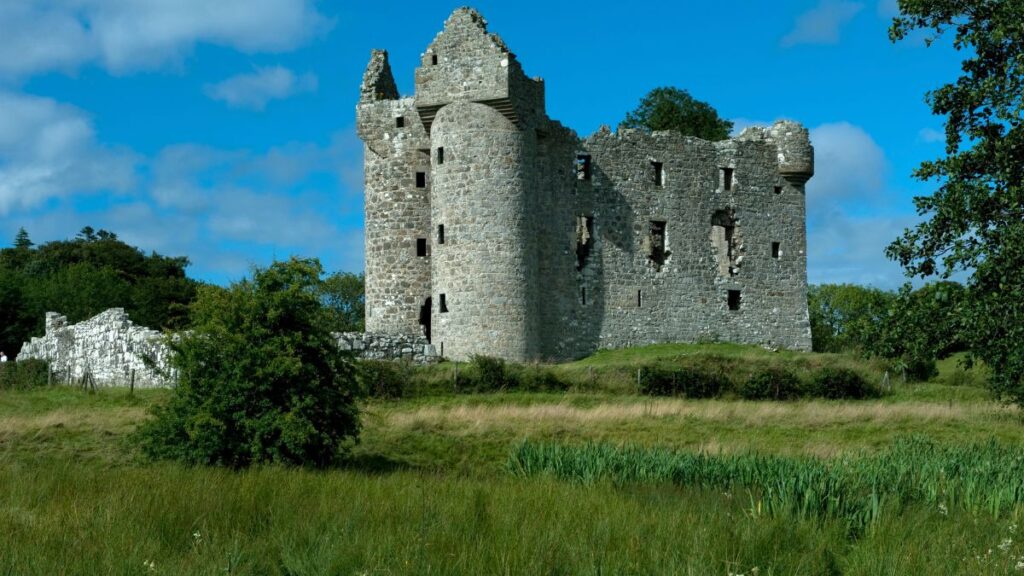
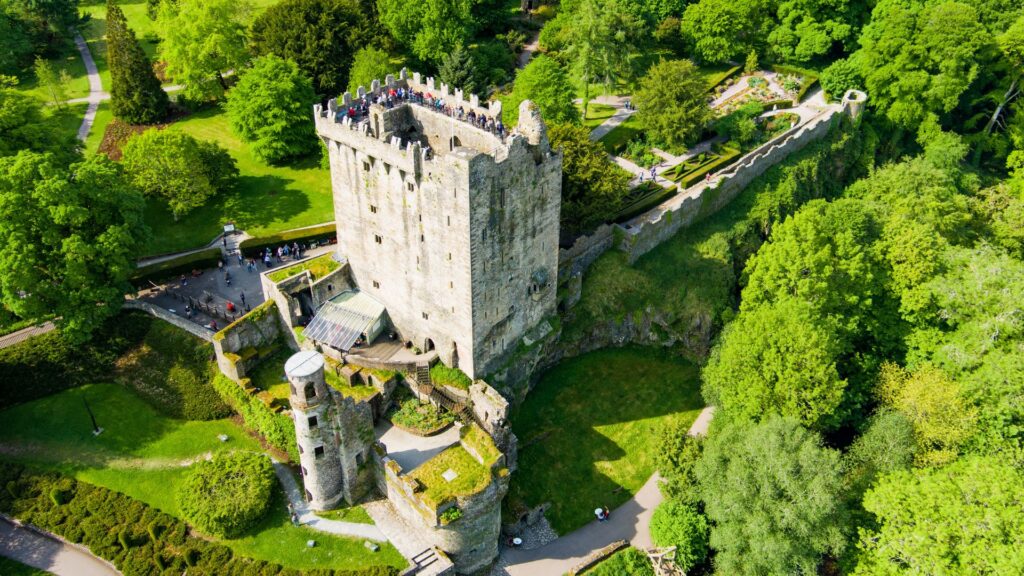
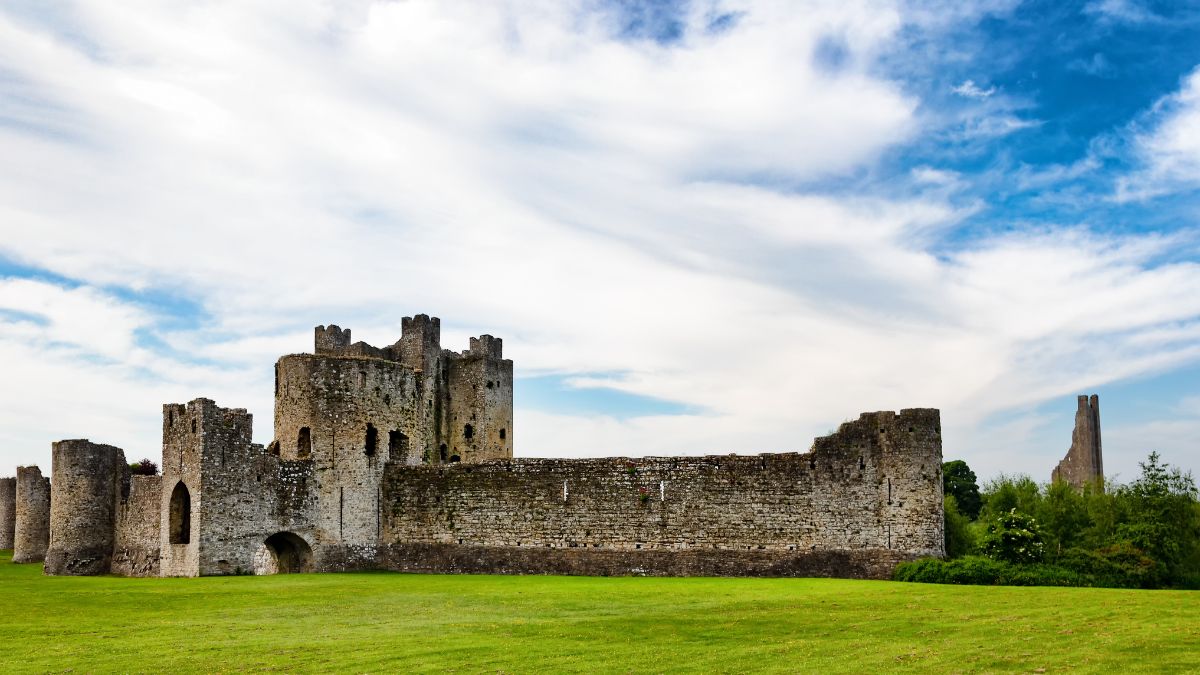
Castle-building was their most visible tool. Stone castles went up across Leinster, Munster, and parts of Connacht, serving as administrative centres, military strongholds, and symbols of power. Many still stand today, including Trim Castle in County Meath, one of the largest Norman castles in Ireland.
Town development was another area where Norman influence is still visible. They founded and expanded towns like Kilkenny, Drogheda, and New Ross, creating trading centres with markets, guilds, and town charters.
Land grants redistributed huge swathes of Irish territory to Norman lords, displacing Gaelic Irish landowners and creating a new feudal hierarchy.
And then there are the surnames. Norman families who settled in Ireland gave rise to surnames that are still common today:
- Fitz (from the French “fils de,” meaning “son of”): FitzGerald, FitzPatrick, Fitzsimons
- De: de Burgo (later Burke), de Courcy, de Clare
- -mund, -mond endings: Desmond, Ormond (from “de Mond” variants)
- Direct Norman names: Roche, Power, Prendergast, Costello, Tobin
If your surname is on that list, you have Norman blood in your family tree.
The Irish fought back, but it was complicated
The Norman conquest was never total. Several Irish kingdoms, particularly in the west and north, resisted effectively. Connacht remained largely under Gaelic control for decades. Ulster was never fully subdued.
And something unexpected happened in the areas the Normans did control: they began to assimilate. Intermarriage between Norman settlers and Irish families became common. Norman lords adopted Irish laws, spoke Irish, and patronised Irish poets and bards. By the 14th century, many descendants of the original Norman settlers were considered “more Irish than the Irish themselves,” as the saying goes.
This alarmed the English crown so much that in 1366, the Statutes of Kilkenny were passed. These laws banned the English settlers in Ireland from:
- Speaking Irish
- Wearing Irish clothing
- Intermarrying with the Irish
- Adopting Irish customs or laws
The very existence of these statutes tells you everything you need to know about how thoroughly the Normans had been absorbed into Irish society. You don’t pass laws banning something that isn’t happening.
What the Normans left behind
The Norman invasion of Ireland didn’t just change who owned the land. It fundamentally altered Irish society in ways that are still being studied and debated by historians.
Language: The Normans introduced Norman French, which influenced early Hiberno-English and contributed to the development of the form of English spoken in Ireland today.
Law: Norman common law gradually replaced Brehon law (the ancient Irish legal system) in many areas, laying the groundwork for the legal structures Ireland would carry into the modern era.
Architecture: The Normans built not just castles but cathedrals, monasteries, and towns. St. Canice’s Cathedral in Kilkenny and Christ Church Cathedral in Dublin both have Norman-era origins.
Agriculture: Norman settlers introduced new farming methods, including the manor system, to many parts of Ireland.
Political identity: Perhaps most significantly, the Norman Conquest of Ireland established the template for English involvement in Irish affairs, a relationship that would define, and often torment, Irish history for the next 800 years.
Why the Norman Conquest of Ireland still matters today
Here’s the thing about this period of history: it’s not just about the 12th century. The Norman invasion of Ireland set in motion a chain of events that shaped the plantation of Ulster, the Penal Laws, the 1798 Rebellion, and ultimately the partition of Ireland in 1921.
Every time you read about the “English” ruling Ireland, you’re reading the downstream consequences of what began with Dermot MacMurrough’s plea for help and Strongbow’s landing on a Wexford beach.
It’s also a story about identity and assimilation. The Normans didn’t just conquer Ireland. They became part of it. And Ireland, in its quiet, stubborn way, absorbed them.
Conclusion
The Norman Conquest of Ireland is one of the most pivotal chapters in Irish history, complex, contested, and still echoing through modern Irish life. It brought castles and surnames and towns. It brought feudal law and foreign lords. And it began an entanglement with England that Ireland would spend centuries trying to unravel.
But it also shows something remarkable about Irish culture: its capacity to absorb those who came to dominate it, to fold conquerors into its own story until the line between invader and native became impossible to draw.
If you want to understand modern Ireland, you have to understand the Normans. And if you want to understand the Normans in Ireland, you have to start right here.
Frequently asked questions about the Norman Conquest of Ireland
How long did the Normans rule Ireland?
The Normans first arrived in Ireland in 1169, and their political influence, through the Lordship and later Kingdom of Ireland under the English crown, lasted until Irish independence in 1922. However, the “Norman rule” in the pure sense faded within a few centuries as Norman settlers became culturally integrated into Gaelic Irish society. By the 14th and 15th centuries, many Norman families had become thoroughly “Hibernicised,” and English crown control over Ireland was reduced to a small area around Dublin known as the Pale.
What Irish surnames are Norman?
Many common Irish surnames have Norman-French origins. Surnames beginning with “Fitz” (from the French for “son of”) are the clearest examples, including FitzGerald, FitzPatrick, and Fitzsimons. Others include Burke (from de Burgo), Roche, Power, Prendergast, Costello, Tobin, Dillon, and Nangle. The “de” prefix in names like de Courcy also points to Norman ancestry. If your surname falls into one of these categories, your family tree likely stretches back to the 12th-century Norman settlers in Ireland.
Why did Normans invade Ireland?
Strictly speaking, the Normans didn’t decide to invade Ireland on their own initiative. They were invited by Dermot MacMurrough, the deposed King of Leinster, who needed military help to reclaim his throne. Dermot recruited Norman-Welsh lords with the blessing of King Henry II of England, who was keen to extend his authority and had papal backing to “reform” the Irish church. What began as a personal political mission for Dermot quickly grew into a broader conquest as Norman lords, scenting opportunity, arrived in increasing numbers.
Were the Normans Catholic or Protestant?
The Normans were Catholic, as were virtually all of Western Europe at the time of the 12th-century invasion. In fact, one of the justifications Henry II used for intervening in Ireland, backed by Pope Adrian IV’s bull Laudabiliter, was bringing the Irish church into closer conformity with Rome. The Protestant Reformation didn’t occur until the 16th century, more than 300 years after the Norman Conquest of Ireland. The Catholic-Protestant divide that would later define so much of Irish history was not yet a factor in 1169.
What language did the Normans speak?
The Normans who invaded Ireland spoke Norman French, a dialect of Old French that had itself been influenced by Norse (the language of their Viking ancestors). They also used Latin for religious and administrative purposes. Over time in Ireland, the Norman settlers gradually shifted toward speaking Irish Gaelic, particularly as intermarriage with local families became common. Later generations of Normans also adopted Hiberno-English, a form of English influenced by both Norman French and Irish Gaelic. By the 14th and 15th centuries, the use of Irish Gaelic among descendants of Norman settlers was so widespread that the Statutes of Kilkenny (1366) attempted to ban it, with limited success.