

If you’ve ever walked into a pub in Galway on a rainy Tuesday evening and heard a fiddle cutting through the noise of a crowd, you already understand something important about the history of traditional Irish music. It doesn’t live in museums. It lives in pubs, in kitchens, in the hands of people who learned a tune from someone who learned it from someone else, stretching back further than any written record can reliably trace.
So, what is the history of traditional Irish music? In short, it’s a story that spans over 2,000 years, shaped by Celtic roots, waves of invasion and colonisation, emigration and diaspora, and a remarkable cultural revival that has kept it not just alive, but thriving. It’s a tradition that absorbed influences from across Europe and the Atlantic, and yet somehow remained unmistakably Irish.
Whether you’re planning a trip to Ireland, digging into your Irish heritage, or just genuinely curious, this guide will walk you through the full story.
Ancient roots: The Celts, harps, and the power of the bard

The earliest chapter of the history of traditional Irish music belongs to the Celts, the ancient people who settled the island around 500 BCE. Music was far more than entertainment for Celtic society. It was spiritual, political, and deeply tied to identity.
At the top of the social hierarchy sat the bard, a trained poet-musician whose job was to compose and perform praise poetry for kings and chieftains, record history in verse, and sometimes deliver cutting satire that could, according to legend, raise blisters on an enemy’s face. These weren’t casual performers. Training as a bard took up to twelve years.
The instrument most associated with this early era is the harp. The Irish harp is actually the national symbol of Ireland, which tells you how deeply it is embedded in the cultural psyche. The earliest harps recovered archaeologically date back to the early medieval period, though the tradition is likely older. Unlike the large concert harp we picture today, the early Irish harp (the clairseach) was wire-strung and played with the fingernails, producing a bright, metallic resonance quite unlike the modern version.
The three types of music that mattered
Medieval Irish texts describe three categories of music that every skilled harper was expected to master:
- Goltraighe: sorrowful music, meant to make the listener weep
- Geantraighe: joyful music, meant to induce laughter and happiness
- Suantraighe: sleep music, meant to lull the listener into rest
This framework shows you that ancient Irish music wasn’t improvised noise. It had purpose, structure, and craft. That idea of music as something intentional and emotionally precise runs right through to the tradition we know today.
The medieval period: Harpers at court and the Gaelic golden age
From around the 10th to the 17th century, the harp tradition flourished under Gaelic patronage. Noble Irish families kept harpers at court in much the same way as European royalty kept court composers. These harpers were given land, status, and protection in exchange for their music.
One name stands above all others from this era: Turlough O’Carolan. Born in 1670, O’Carolan lost his sight to smallpox as a teenager and went on to become the most celebrated harper-composer in Irish history. He composed over 200 pieces, many of which are still played today at traditional sessions around the world. His work blended native Irish melody with the baroque European influences he encountered while travelling the country on horseback. If there’s a bridge between old Gaelic Ireland and the European musical world, O’Carolan built a good portion of it.
Colonisation and suppression: when music became resistance

The 16th and 17th centuries brought a dramatic and painful shift. English colonisation dismantled the Gaelic social order, and with it, the structures that had supported professional musicians. The Penal Laws introduced in the late 17th and early 18th centuries targeted Catholic Irish life broadly, though historians debate the extent to which music specifically was banned versus simply deprived of its patronage system.
What we do know is that music went underground. It moved from great halls to small cottages. It shifted from solo harpers performing for aristocrats to communal gatherings where people played together for their own enjoyment and survival. This shift had a profound effect on the tradition. It became more democratic, more participatory, and more community-centred.
Crucially, it was during this period that instruments like the fiddle, tin whistle, and uilleann pipes began to define the sound of Irish traditional music. The uilleann pipes in particular are a fascinating instrument: uniquely Irish, bellows-driven (played under the elbow rather than blown), and capable of extraordinary range and expression. They sound unlike any other instrument in the world.
The Belfast harp festival of 1792: A last attempt to save a dying art
By the late 1700s, the old harp tradition was in serious decline. Recognising this, a group of Irish cultural nationalists organised the Belfast Harp Festival in 1792, bringing together the last surviving harpers in Ireland, most of them elderly and blind, to perform and have their repertoire recorded.
A young musician named Edward Bunting was hired to transcribe the tunes. He published the results in three collections between 1796 and 1840, and in doing so, preserved a body of music that might otherwise have vanished entirely. Bunting’s work is one of the most significant acts of musical preservation in Irish history, and it directly inspired the later work of collectors like Francis O’Neill.
The Great Famine and emigration: how Irish music spread across the world
The Great Famine of 1845 to 1852 devastated Ireland. The population dropped from around eight million to roughly six million, through death and emigration. The cultural consequences were enormous. Irish communities formed in Boston, New York, Chicago, Liverpool, Sydney and beyond, and they brought their music with them.
One of the most consequential figures in the diaspora story is Francis O’Neill, a County Cork man who emigrated to America and eventually became Chief of Police in Chicago. In his spare time, he obsessively collected Irish tunes from Irish immigrants across the city. His 1903 publication, “O’Neill’s Music of Ireland”, contained 1,850 tunes and became the single largest collection of Irish traditional music ever assembled. It’s still used by musicians today.
The diaspora also gave traditional Irish music new energy. In America, Irish music mixed with other folk traditions, influencing and being influenced by Appalachian music, bluegrass, and country. You can hear the Irish fiddle in the American South if you listen carefully enough.
A session in Doolin: what the tradition feels like from the inside
The best way I can describe what traditional Irish music really is comes from a session I stumbled into at McGann’s pub in Doolin, County Clare. It was a weeknight in October, cold and wet outside, and I had no idea there’d be music on. A fiddle player and a flute player had started a reel in the corner. By the time I’d ordered a pint, two more musicians had pulled out their instruments and joined in, no signal given, no conductor, no set list.
That’s the session, and it’s the heartbeat of the whole tradition. Nobody’s performing at you. They’re playing with each other. If you know a tune, you join. If you don’t, you listen. The music is passed between people like a conversation, and it’s been happening in some form for hundreds of years. County Clare, in particular, is widely regarded as one of the spiritual homes of traditional Irish music, and if you find yourself there, don’t miss a session in one of the best pubs with live music in Ireland.
The 20th-century revival: Comhaltas, Chieftains, and the Fleadh Cheoil
By the mid-20th century, traditional music was at risk of being swamped by American pop and jazz, which flooded Ireland through radio and cinema. The response was a cultural counter-movement.
In 1951, Comhaltas Ceoltoiri Eireann was founded, an organisation dedicated to preserving and promoting Irish traditional music, song, and dance. It established a network of branches (called “craobhacha”) across Ireland and later worldwide, and created the Fleadh Cheoil, an annual festival and competition that brings hundreds of thousands of people together. The Fleadh is not just a concert. It’s a gathering where musicians at every level compete, perform informally on street corners, and pass tunes to each other for days.
At the same time, a group called The Chieftains were reintroducing traditional Irish music to international audiences with extraordinary skill and ambition. Founded in 1962 by Paddy Moloney, they collaborated with everyone from the Rolling Stones to Van Morrison to Ry Cooder. They showed the world that this music didn’t need to be quaint or niche. It could stand on any stage.
The folk revival and beyond: Planxty, The Bothy Band, and a new generation

The 1970s brought an even more electric development. Bands like Planxty, The Bothy Band and The Dubliners took traditional tunes and played them with a rock-band urgency that was completely new. Planxty in particular, with Christy Moore’s powerful voice and Andy Irvine’s Balkan-influenced guitar, created something that felt both ancient and urgent.
This era produced some of the most loved recordings in Irish music history and introduced a generation of young people to the tradition who might otherwise have turned away from it. Musicians who grew up listening to Planxty in the 70s are the session players you’ll find in pubs today.
The Irish language and traditional music
It’s impossible to fully understand the history of traditional Irish music without touching on the Irish language. Sean-nos singing, which translates roughly as “old style”, is a form of unaccompanied vocal music sung entirely in Irish. It’s considered by many to be the purest and most ancient surviving form of Irish musical expression.
The singing style is characterised by ornamentation, rhythmic flexibility, and an intensely personal delivery. No two singers perform the same song in the same way. It’s the opposite of standardised. And it’s most alive in the Irish speaking areas in Ireland, particularly Connemara, Donegal, and the Dingle Peninsula, where it’s still passed down within families and communities rather than through formal teaching.
The instruments at the heart of the tradition
Part of what makes traditional Irish music so recognisable is its instrumental palette. Here’s a quick rundown of the main players:
- Fiddle: the most common instrument in sessions, played with a lively, driving bow technique distinct from classical violin playing
- Uilleann pipes: Ireland’s unique bellows-blown bagpipe, with a haunting, complex sound
- Tin whistle: deceptively simple looking, but capable of great expression in skilled hands
- Flute: usually a simple-system wooden flute, quite different in tone from the orchestral flute
- Bodhran: the hand-held frame drum, introduced to sessions in the 1960s and somewhat controversial among traditionalists
- Bouzouki and guitar: came into the tradition in the 1970s and are now accepted accompaniment instruments
- Irish harp: making a strong revival today, particularly among young players who are reconnecting with the oldest strand of the tradition
Traditional Irish music today: thriving, evolving, and global
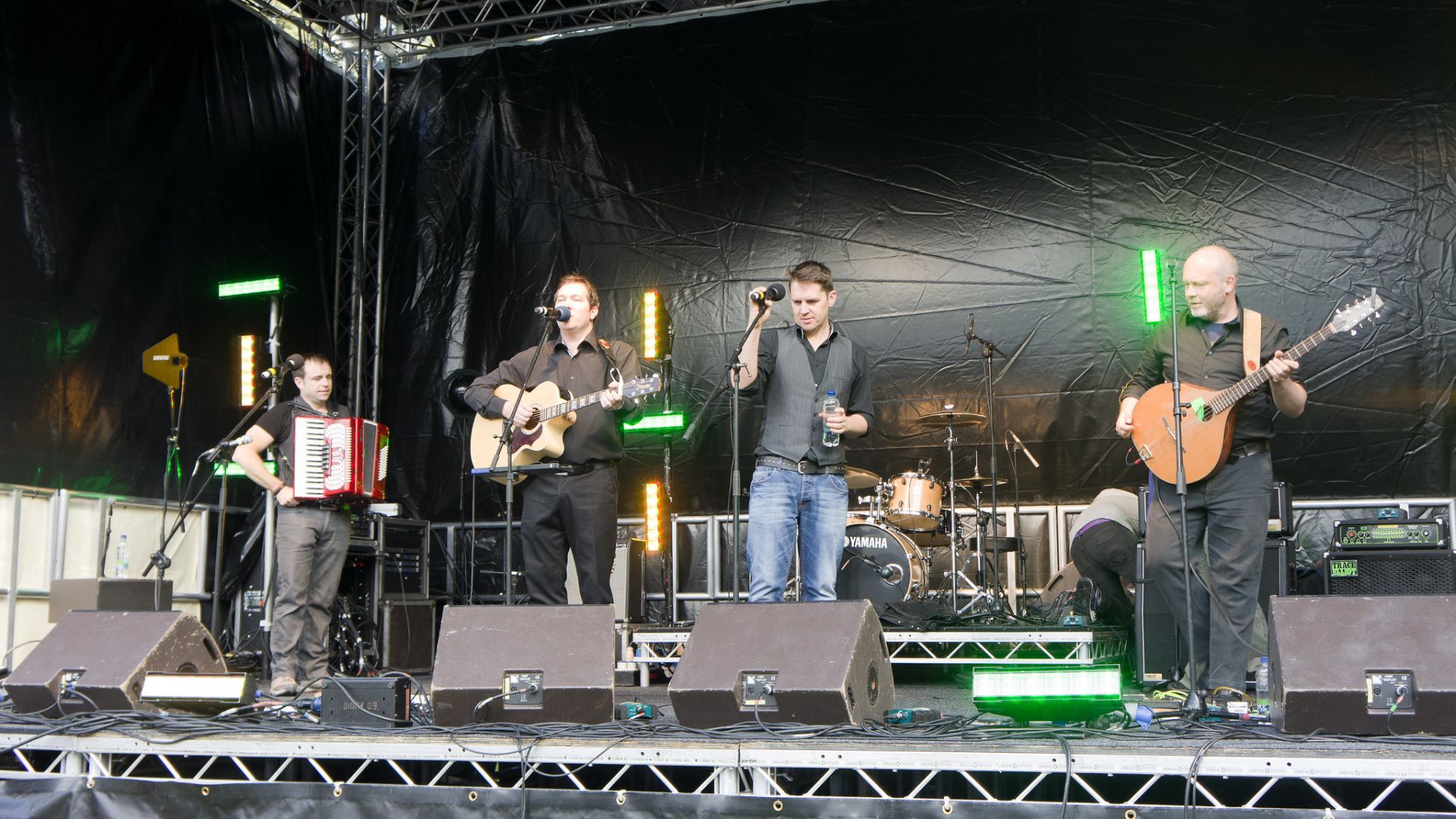
Today, the history of traditional Irish music continues to be written in real time. Artists like Liam O’Flynn, Frankie Gavin, Sharon Shannon, and more recently groups like Ye Vagabonds, Lankum, and Lisa O’Neill are taking the tradition in genuinely new directions without abandoning what makes it distinctively Irish.
Sessions are held in Irish pubs across Tokyo, Buenos Aires, Sydney, and New York. There are online communities where musicians share recordings and debate the correct ornaments for a particular reel. Children in Ireland are learning to play the tin whistle in primary schools. Comhaltas has hundreds of branches on every continent.
Conclusion
The history of traditional Irish music is a story about survival. It survived colonisation, famine, emigration, and cultural suppression. It survived modernisation and the onslaught of global pop culture. And it kept going because ordinary people loved it enough to keep passing it on, tune by tune, note by note, generation by generation.
If you want to experience it properly, you really have to hear it live. Find a session pub, order a pint, sit close enough to feel the bow strokes, and just listen. The history of 2,000 years will be playing in front of you.
Frequently asked questions about traditional Irish music
What is traditional Irish music called?
Traditional Irish music is most commonly called “trad” or “Irish trad” among musicians and enthusiasts. The more formal term is “ceol traidisiunta” in the Irish language. Within the tradition, you’ll also hear specific genres named, such as sean-nos (old style unaccompanied singing), jigs, reels, hornpipes, and slow airs, each of which refers to a particular rhythm or style of playing.
What is the most traditional Irish song?
This is a question that sparks genuine debate. Many consider “Danny Boy” (set to the tune “Londonderry Air”) to be the most iconic Irish song internationally, though traditional musicians often point out that its most famous lyrics were written by an Englishman, Frederic Weatherly, in 1913. For something rooted deeper in the Gaelic tradition, sean-nos songs like “Caoineadh na dTri Muire” (Lament of the Three Marys) are considered among the most authentic and ancient.
What is the traditional music of Ireland?
The traditional music of Ireland encompasses a wide range of styles: instrumental dance music (jigs, reels, hornpipes, polkas), slow airs, sean-nos singing, and songs in both the Irish and English languages. It’s defined less by a single sound and more by a set of values: music learned orally, played communally, heavily ornamented, and rooted in regional traditions that vary from County Clare to Donegal to Kerry.
What is a famous Irish folk song?
Some of the most famous Irish folk songs include “The Wild Rover”, “Whiskey in the Jar”, “Black Velvet Band”, “The Fields of Athenry” (written in 1979 but now a near-anthem), and “Molly Malone”. In the instrumental tradition, tunes like “The Morning Dew”, “The Bucks of Oranmore”, and “The Dingle Set” are session classics. The line between “folk song” and “traditional song” is genuinely blurry in Ireland, and most musicians use the terms interchangeably.
What is the oldest song in Ireland?
Pinpointing “the oldest song” is genuinely difficult because of the oral tradition. Many tunes and songs exist in forms that are centuries old but can’t be precisely dated. One of the oldest documented melodies is the “Lament for the Death of Fionn Mac Cumhail”, traced back to medieval Gaelic manuscripts. Edward Bunting’s 1796 collection includes tunes believed to date to the medieval period. In the sean-nos tradition, certain laments and hymns in Irish are considered to be among the oldest continuously performed musical pieces in Europe.