


There’s a circle of darker grass in a field outside Ennis, County Clare. The farmer who owns that land won’t touch it. His grandfather wouldn’t touch it. And if you asked him why, he’d probably just shrug and say, “You don’t want to be messing with that.”
That circle is a fairy ring. And what lives inside it, according to centuries of Irish tradition, is something far more complex than the cute, winged sprites you might be picturing.
So, who are the Aos Sí?
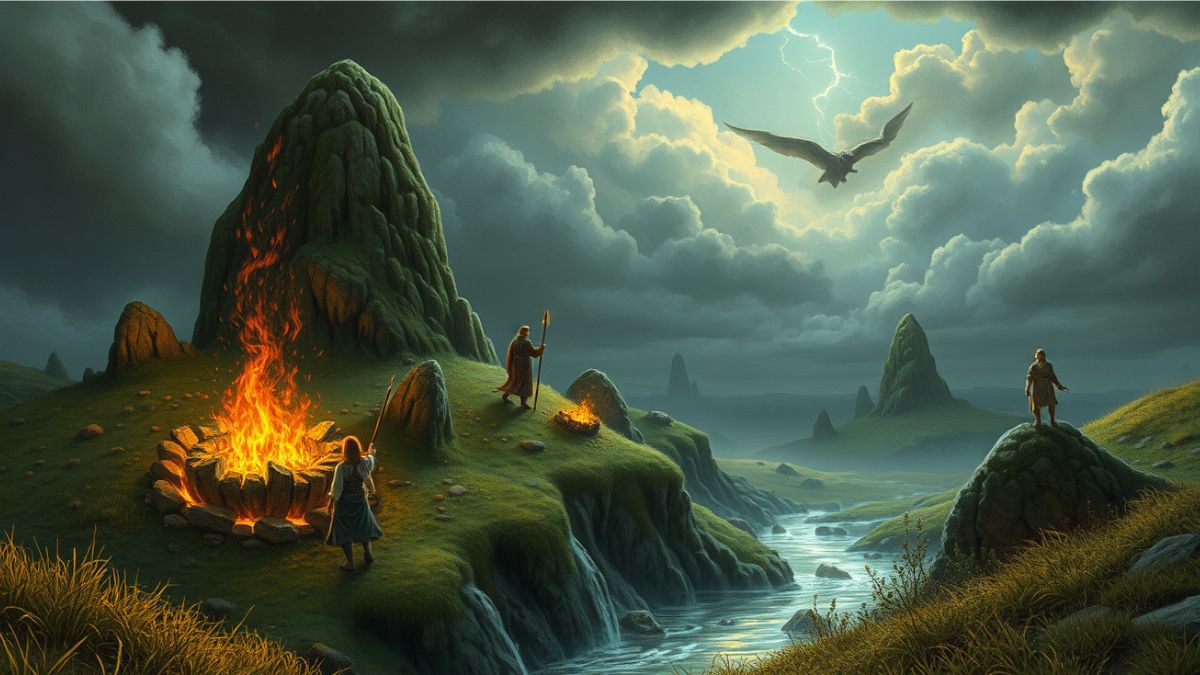
The Aos Sí (pronounced “ees shee”) are the supernatural beings of Irish mythology, sometimes called the fairy folk or the “people of the mounds.” They’re not fairies in the Victorian picture-book sense. They’re older than that. More powerful. More dangerous.
Think of them as a race of beings who once ruled Ireland and now exist in a parallel world just slightly out of reach, occasionally brushing against ours in ways that can be wondrous or catastrophic, depending on how you treat them.
The name itself gives you a clue. “Aos” means people or folk in Irish, and “Sí” refers to the fairy mounds, the ancient burial sites, and hills where these beings are said to dwell. So the Aos Sí are literally “the people of the mounds.”
They go by many names: the Daoine Sídhe, the Good People, the Fair Folk, the Gentry. The fact that people historically avoided saying their name directly and instead reached for flattering substitutes tells you everything about the respect and fear they commanded.
From gods to the underground: the origin story of the Aos Sí
To understand who the Aos Sí really are, you need to go back to the mythological history of Ireland.
According to the Lebor Gabála Érenn, the Book of Invasions, Ireland was settled by successive waves of supernatural peoples before the arrival of the Gaels. The last of these divine races were the Tuatha Dé Danann, a god-like people with extraordinary gifts in poetry, craft, healing, and battle.
When the Gaels finally arrived and defeated them, something unusual happened. The Tuatha Dé Danann didn’t vanish. They didn’t die. Instead, they retreated underground, into the hills, the ancient burial mounds, and the hollow places of the earth. These sacred mounds, called “sídhe” (fairy mounds), became their new domain.
And the Tuatha Dé Danann, now hidden from view, became what we know as the Aos Sí.
This is a crucial point that most articles miss: the Aos Sí aren’t a separate mythological species invented for folklore. They are the old gods, diminished in status but not in power, living just beneath the surface of the world you walk through every day in Ireland.
Some of the most famous figures from Irish mythology made that transition with them, including the Dagda, the all-father god; the Morrigan, goddess of war and fate; and Manannán mac Lir, the lord of the sea and the otherworld.
What do fairy rings have to do with any of this?
A lot, actually.
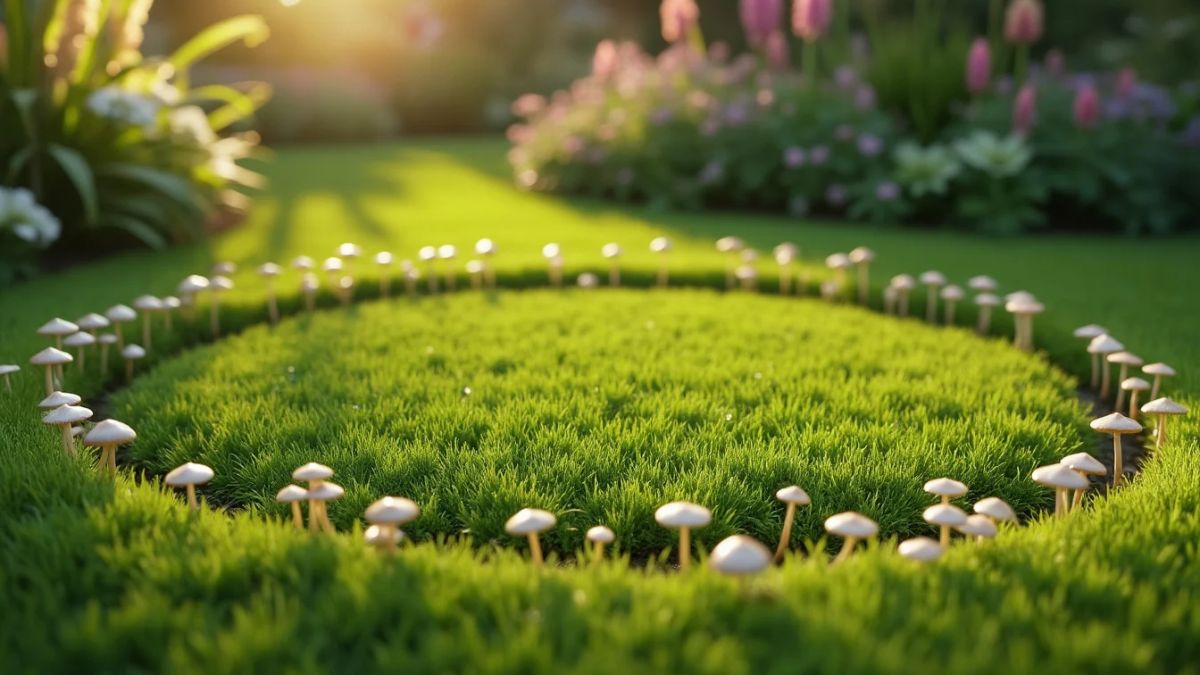
Fairy rings are circles that appear naturally in grass and meadows, often marked by a ring of mushrooms, a darker band of lush green grass, or a ring of dead and bare earth. Scientists will tell you they’re caused by fungal growth spreading outward from a single point underground. The leading edge of the fungus releases nutrients that cause the grass to grow more vigorously, while the inner area becomes depleted.
All of that is true. And in Ireland, it’s also considered completely beside the point.
Because in Irish folk tradition, fairy rings are understood as the places where the Aos Sí dance. Some say they’re gateways into the sídhe, the underground realm. Others say they mark the boundaries between our world and theirs. Still others believe they’re simply places of concentrated fairy power, locations where the veil between worlds is thin enough to feel.
Whatever the explanation, the rules around fairy rings have remained consistent across Irish folklore for hundreds of years:
- Don’t step inside one, especially at night or during liminal times like dusk, dawn, or the turning of the seasons.
- Don’t build on or near one. Roads in Ireland have been rerouted around fairy rings. Houses have been built with unusual angles to avoid them. This still happens.
- Don’t disturb them by digging or cutting. The consequences in folklore range from bad luck and illness to sudden death.
- If you do step inside, you may not be able to get out. Or you might step out to find that years have passed while you were dancing with the Aos Sí.
That last point connects to one of the most enduring themes in Aos Sí folklore: time moves differently in their world.
Time, enchantment, and the danger of fairy hospitality
Stories of people being taken by the Aos Sí, or lured into their world, run through Irish folklore like a river. They’re not just fairy tales. Many were told as cautionary accounts, real warnings passed from generation to generation.
The pattern is usually the same. Someone encounters the fairy folk, often near a ring, often at a liminal time. They’re invited to join a feast, a dance, a celebration. The music is extraordinary. The food and drink are like nothing they’ve tasted. They stay.
And when they finally leave, they discover that what felt like a single night was seven years. Or seventy.
This motif isn’t unique to Ireland, but it’s particularly vivid in Irish tradition because of the physical locations attached to it. These stories aren’t set in vague “enchanted forests.” They’re set in specific places. That ring on the hill above the village. That field at the edge of town. When a story has coordinates, it becomes harder to dismiss.
The Aos Sí weren’t just entertainment. They were a way of explaining why you needed to respect certain spaces, behave a certain way at certain times, and understand that the world is layered in ways you can’t always see.
The Aos Sí in daily Irish life: more present than you’d think

What’s genuinely surprising, if you spend time in rural Ireland, is how undead this belief system is.
In 1999, a major road development in County Clare was redirected at significant expense because it would have disturbed a whitethorn tree, a lone fairy tree, considered sacred to the Aos Sí. The decision made international headlines, mostly because the coverage treated it as quaint. But locally, it was just common sense.
Lone hawthorn trees, especially those growing in unusual positions in the middle of fields, have long been associated with the Aos Sí. Cutting one down is considered deeply bad luck. Fairy rings get the same treatment.
This isn’t pure superstition preserved in amber. It functions more like a live ethical framework for relating to the landscape. You don’t disturb fairy rings for the same reason you don’t litter in a cathedral. The space has meaning. It deserves respect.
In some ways, the Aos Sí belief system encoded a form of ecological respect into the culture. Certain trees, certain fields, and certain springs were off-limits, which meant they were protected. The fairy folk provided the justification. The land benefited.
The hierarchy of the Aos Sí: not all fairy folk are equal
The Aos Sí isn’t one uniform group. Irish mythology gives us a detailed internal structure of this supernatural world, and it’s worth knowing who’s who.
Banshees (Bean Sídhe): The “woman of the fairy mound.” A banshee doesn’t cause death; she announces it. Her wailing cry, heard outside a home, means someone inside will die. She’s attached to specific Irish families, particularly those with “O'” or “Mac” in their names. She’s a harbinger, not a predator.
Pookas (Púca): Shape-shifting tricksters who might appear as a dark horse, a goat, or a goblin. They can be helpful or deeply disruptive depending on their mood and how you treat them. Leave them an offering of grain after the harvest, and you might be fine.
Leprechauns: Yes, they’re real in the sense that they have genuine roots in the Aos Sí tradition. The “leipreachán” is a fairy cobbler, usually heard before seen, the sound of hammering giving him away. He guards hidden treasure. The comedy-souvenir version of the leprechaun has almost nothing to do with the original figure.
The Sluagh: The most feared of all. These are the unsettled dead, the hostile dead, who travel in groups on the wind from the west. They try to carry souls away. Windows on the west side of houses were sometimes kept shut during illness to keep them out.
The Cú Sídhe (fairy hound): A massive supernatural dog, usually described as dark green, whose baying comes in threes. If you hear it a third time, you won’t survive the encounter.
Samhain and the Aos Sí: why Halloween is actually about this
You can’t talk about the Aos Sí without talking about Samhain, the ancient Celtic festival held at the end of October that directly became Halloween.
Samhain was the moment when the boundary between the world of the living and the world of the Aos Sí became its thinnest. The sídhe, the fairy mounds, were said to open. The Aos Sí could move freely in the human world. The dead could return.
People would leave offerings outside their doors, food, milk, sometimes silver, to appease the fairy folk and ensure their household was passed over. They’d dress in costumes to confuse the spirits or blend in with them. They’d light bonfires to guide the dead and ward off hostile supernatural forces.
Almost every Halloween tradition you know has a direct line back to the Aos Sí and the beliefs surrounding them. The “trick or treat” dynamic maps almost perfectly onto the old practice of leaving offerings to avoid supernatural trouble.
Fairy rings were considered especially powerful and especially dangerous at Samhain. This was not the time to be walking near one after dark.
Finding fairy rings in Ireland today: what to look for
If you’re travelling in Ireland and want to look for fairy rings, you’re in luck. They’re everywhere, and they’re not hard to spot once you know what you’re looking for.
What to look for:
- A perfect or near-perfect circle of darker, lusher grass in a field or meadow.
- A ring of mushrooms (often appearing in autumn after rain).
- A bare, worn circle of earth with no growth inside.
- A ring of lighter grass surrounded by darker growth.
Some places where you’re particularly likely to encounter them:
- The Burren in County Clare, where the thin limestone landscape seems to magnify every unusual feature.
- The rolling drumlins of County Cavan and Monaghan.
- The ancient landscape around the Hill of Tara in County Meath.
- Essentially, any old farm field that hasn’t been intensively ploughed in decades.
The best rule of thumb is: look for fields with old hedgerows, older land use patterns, and you’ll find them.
And when you do, by all means photograph them. Look at them closely. Wonder at the fungal mathematics that creates something so geometrically perfect in the wild.
Just maybe don’t step inside. Not at dusk, anyway.
Conclusion
The Aos Sí aren’t a relic. They’re not something that Irish culture filed away under “old stories” and moved on from. They’re woven into the landscape, the calendar, the way people relate to the land and to the idea of things that exist just beyond ordinary perception.
Fairy rings are the most visible expression of that relationship. They’re places where the geometry of nature and the geometry of belief happen to coincide, and where centuries of stories have deposited their weight.
Whether you come to this as a folklore enthusiast, a traveller, a sceptic, or someone who just found a strange circle in a field and started googling, the Aos Sí reward curiosity. The more you learn about them, the more you understand that Irish mythology isn’t a finished text. It’s a living conversation between the past and the present, carried on in fields and fairy rings across the entire island.
Treat it with respect. That’s really all anyone ever asked.
Frequently asked questions
Are the Aos Sí fairies?
Yes and no. The Aos Sí are often translated as “fairies” in English, and that’s a reasonable shorthand. But the fairy folk of Irish tradition bear very little resemblance to the small-winged creatures of Victorian fantasy. The Aos Sí are ancient, powerful, and morally complex beings, more akin to gods who retreated underground than to the diminutive figures of later European folklore. The word “fairy” undersells them considerably.
What is the difference between the Tuatha Dé Danann and the Aos Sí?
They’re the same beings at different points in Irish mythological history. The Tuatha Dé Danann were the divine race who ruled Ireland before the arrival of the Gaels. When they were defeated, they retreated into the fairy mounds and became the Aos Sí. You can think of the Tuatha Dé Danann as their name when they were in power, and the Aos Sí as their name after they went underground. The transition is a demotion in status, not a change in nature.
How tall are the Aos Sí?
Irish mythology doesn’t give us a single consistent answer. The Aos Sí are sometimes described as being tall and of noble bearing, essentially human-sized but more beautiful and more luminous. At other times, individual Aos Sí figures (particularly the leprechaun) are described as small. The ability to change size and shape is attributed to the fairy folk generally, so a fixed height may simply not apply to them.
Where do the Aos Sí live?
The Aos Sí are said to live in the sídhe, the fairy mounds, which are often identified with Ireland’s ancient burial mounds and passage tombs, structures like Newgrange, Knowth, and Brú na Bóinne. They’re also associated with the otherworld, a parallel realm sometimes called Tír na nÓg (the Land of Youth) or Mag Mell (the Plain of Delight). The fairy rings found in fields are considered doorways or gathering points connected to these underground realms.
What does “Aos” mean in Irish?
“Aos” (also spelled “aes”) is an Old Irish word meaning “people,” “folk,” or “class of beings.” It’s used in compound words throughout Irish mythology: “Aos Dána” means “people of skill” or “gifted people” and was the name for poets and artists of high status. “Aos Sí” therefore means “people of the fairy mounds” or “folk of the hills,” referring collectively to the supernatural beings associated with the sídhe.


