


There’s a moment, standing on the windswept hill of Tara in County Meath, when the past doesn’t feel so far away. The landscape rolls out in every direction, soft and ancient, and you can almost believe that something extraordinary happened here a very long time ago. Something involving beings that were neither fully human nor entirely divine.
That’s the effect the Tuatha Dé Danann tend to have on people.
So, who are the Tuatha Dé Danann? In short, they are the supernatural race at the heart of Irish mythology. The name translates roughly as “the peoples of the goddess Danu” or “the tribes of the gods.” They were depicted as tall, luminously beautiful, and extraordinarily powerful, skilled in magic, craftsmanship, and warfare. In the ancient texts of the Mythological Cycle, they arrived in Ireland as its fourth wave of settlers, defeated the monstrous Fomorians, ruled the land, and were eventually driven underground by the Milesians (the ancestors of the modern Irish people), where they became the fairy folk of later legend.
But that single paragraph barely scratches the surface of one of Europe’s richest mythological traditions.
Where did the Tuatha Dé Danann come from?

One of the most striking things about Irish mythology is how specific it gets about origins. The Tuatha Dé Danann didn’t just appear out of nowhere. According to the Lebor Gabála Érenn (the Book of Invasions, a medieval compilation of Irish origin myths), they came from four mysterious northern cities: Falias, Gorias, Murias, and Finias.
In each city, they studied under a great druid master, learning magic, craft, and wisdom. And when they finally left for Ireland, they brought with them four legendary treasures:
- The Lia Fáil (the Stone of Destiny), which cried out beneath the feet of every rightful High King of Ireland.
- The Spear of Lugh, which never missed its mark and from which no one could recover once struck.
- The Sword of Nuada, from which no enemy could escape once drawn.
- The Cauldron of the Dagda, which could never be emptied and left no one unsatisfied.
These weren’t just magical props. Each treasure represented a core value in Irish society: sacred kingship, military power, justice, and abundance. The Tuatha Dé Danann were, among other things, a mythological framework for understanding what it meant to rule and to live well.
As for whether they arrived by ship or by magical mist, the sources can’t quite agree. Some say they landed on the shores of Connacht, burning their boats behind them so there could be no retreat. Others say they descended from the clouds themselves. That ambiguity feels very deliberate. These were beings who existed between worlds.
The great battles: how the Tuatha Dé Danann won and lost Ireland

The story of the Tuatha Dé Danann in Ireland is essentially a story of two pivotal wars, both fought at Mag Tuired (often identified with County Roscommon or Sligo today).
The First Battle of Mag Tuired
When the Tuatha Dé Danann arrived, Ireland was already occupied by the Fir Bolg. Rather than immediate war, there was first a negotiation, an offer to divide the island equally. It was refused. The battle that followed was devastating. The Tuatha Dé Danann won, but their king, Nuada, lost his arm in the fighting.
Here’s where it gets interesting. Under Irish mythological law, a king had to be physically perfect. Nuada, with his arm gone, could no longer rule. So for a period, a figure called Bres (who was half-Fomorian) took the kingship. It didn’t go well. Bres was stingy, humourless, and favoured his mother’s people over the Tuatha Dé Danann. Meanwhile, the great physician-god Dian Cécht fashioned Nuada a fully functioning arm of silver, earning him the title Nuada Airgetlám (Nuada of the Silver Arm).
Eventually, Nuada was restored to the throne, and Bres fled to his father’s people, the Fomorians, seeking an army for revenge.
The Second Battle of Mag Tuired
This is one of the great set pieces of Irish myth, a genuinely dramatic story involving treachery, divine prophecy, single combat, and one of mythology’s most famous last-minute heroes.
The Fomorians, led by the terrifying Balor of the Evil Eye (whose gaze could kill an army), arrived in force. The Tuatha Dé Danann, now led by Lugh (a young god of extraordinary, multi-skilled talent who had arrived at Tara and talked his way in by claiming to be master of every single craft at once) fought back with everything they had.
The climax came when Lugh faced Balor directly. Balor’s eye required four men to lift the lid, and one look could destroy an army. Lugh used a sling stone to drive the eye back through Balor’s own head, destroying his forces in one blow. Some versions say Lugh was Balor’s own grandson, fulfilling a prophecy that had haunted the Fomorian chief his entire life.
The Fomorians were defeated and driven from Ireland for good.
And then came the Milesians
The Tuatha Dé Danann’s reign eventually ended not through a great battle but through something more bittersweet. The Milesians, a race of mortal men descended from the mythological Míl Espáine, arrived in Ireland and challenged them. After a series of negotiations, agreements, and betrayals, the Tuatha Dé Danann were defeated.
Their fate, though, was not extinction. They retreated underground, into the hollow hills, the sídhe (fairy mounds), places like Newgrange, Knocknarea, and the Hill of Tara itself. In doing so, they became the Aos Sí, the fairy folk, the beings who haunt Irish legend ever after: sometimes helpful, sometimes dangerous, always powerful.
It’s a poetic resolution. The old gods didn’t die. They just… went elsewhere. Just beneath the surface of the world, still watching.
The most famous of the Tuatha Dé Danann
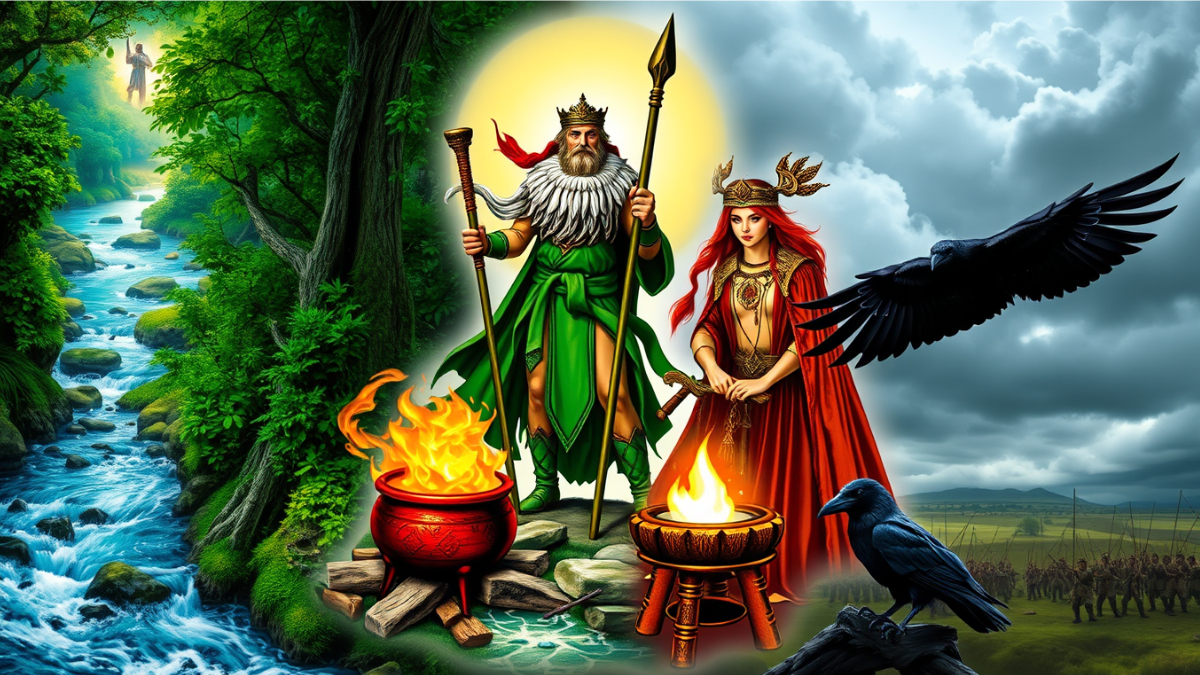
The Tuatha Dé Danann included dozens of named beings, but a handful have become truly iconic in Irish culture.
The Dagda: The good god
Despite his name (which means “the good god” in the sense of “skilled” rather than morally virtuous), the Dagda is often depicted as enormous, ungainly, and slightly comical. He drags a massive club that can kill with one end and restore the dead with the other. He owns the magical cauldron. He controls the seasons.
What makes the Dagda fascinating is that he embodies a very Irish kind of power: practical, earthy, and deeply rooted in the land itself. He’s not a sky god hurling thunderbolts. He’s the god of agriculture, contracts, seasons, and feasting. The kind of deity you’d actually want around.
Lugh: The many-skilled
Lugh Lámhfhada (Lugh of the Long Arm) is arguably the most dynamic figure in the whole mythology. He’s skilled in every craft, a warrior, a craftsman, a poet, a historian, a sorcerer. When he arrived at the fortress of Tara, the gatekeeper asked what skill he brought. Lugh listed dozens. Each time, the gatekeeper told him they already had someone who could do that. Finally, Lugh asked: “Do you have anyone who is master of all of them?” The gates opened.
He’s been compared to the Welsh Lleu and the Roman Mercury. His festival, Lughnasadh (still celebrated as a harvest festival in parts of Ireland), falls on August 1st, and some scholars believe the city of Lyons in France was named after him.
The Morrigan: Goddess of fate and war
The Morrigan is one of the most complex figures in all of Celtic mythology. She’s simultaneously a goddess of war, fate, sovereignty, and prophecy. She often appears as a crow or raven on a battlefield. She’s associated with both death and transformation.
Her relationship with the hero Cú Chulainn (who belongs to a later mythological cycle) is one of myth’s great love-hate stories: she offers herself to him, he refuses to recognise her, and she spends the rest of his life alternately hindering and helping him, right up to his death.
The Morrigan has experienced a significant cultural resurgence in recent decades, appearing in video games, fiction, and modern pagan practice. She represents something that still resonates: the idea that fate is not punishment but transformation.
Brigid: Fire, poetry, and healing
Brigid, daughter of the Dagda, is the goddess of poetry, smithcraft, and healing. Her festival, Imbolc, falls on February 1st and marks the first stirrings of spring on the Irish calendar. Her influence was so profound that when Christianity arrived in Ireland, she was transformed into Saint Brigid (whose feast day is still February 1st), one of the most beloved saints in Irish tradition.
It’s a remarkable case of mythological continuity. The goddess became the saint, and the veneration never really stopped.
Why the Tuatha Dé Danann still matter today
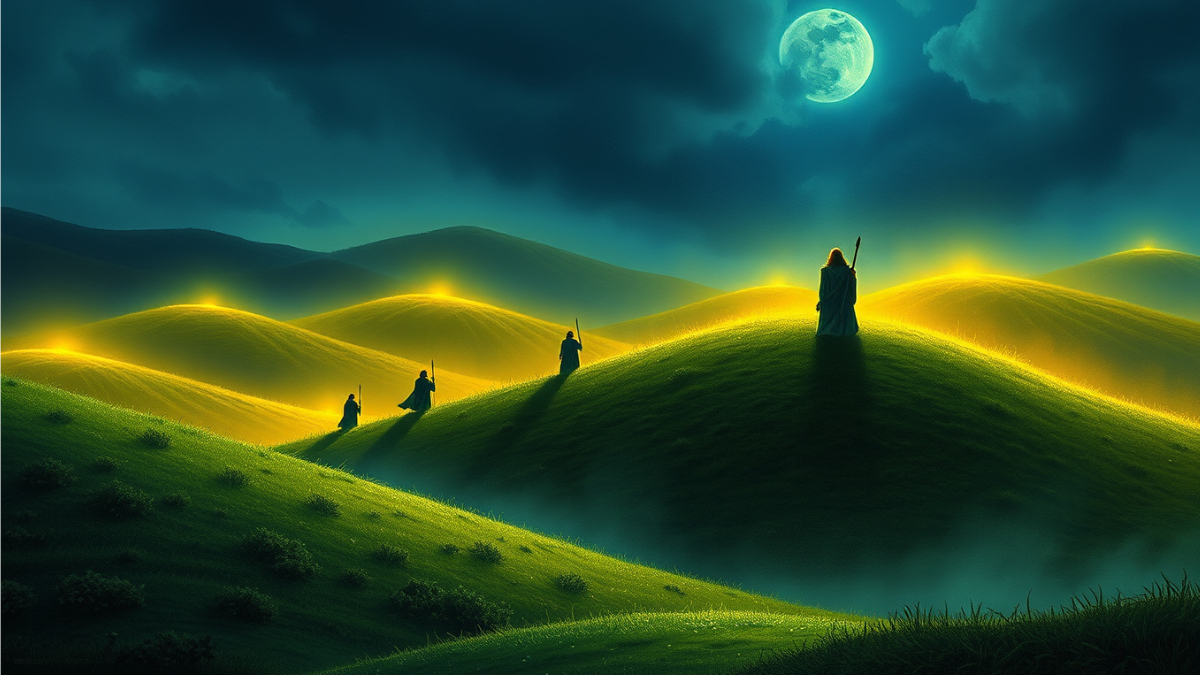
It would be easy to treat all of this as pure antiquarianism, a dead mythology from a long-gone world. But that would be a mistake.
The stories of the Tuatha Dé Danann are still alive in the Irish landscape. Newgrange, that astonishing 5,000-year-old passage tomb in the Boyne Valley, is identified in myth as the home of the Dagda and the entrance to the otherworld. The Hill of Tara, Ireland’s ancient seat of High Kingship, is still understood as a place of mythological power. Knocknarea in Sligo, the cairn believed to hold the legendary Queen Maeve, draws visitors who leave stones as offerings.
These are not museums. They’re living sites, bound up in a story that hasn’t finished being told.
Modern Irish writers, from W.B. Yeats to contemporary fantasy authors, have returned again and again to the Tuatha Dé Danann for inspiration. They appear in video games, in tattoo art, in the names of Irish businesses and sporting teams. There’s something in these stories that continues to resonate: the idea of a world where beauty and danger are inseparable, where the land itself is sacred, and where the old powers never truly departed.
They just went underground. And according to Irish tradition, they’re still there.
Conclusion
The Tuatha Dé Danann are more than mythology. They’re a lens through which ancient Irish people understood the world: how power should be used, what makes a good ruler, how the sacred and the everyday overlap, and what happens to greatness when the world changes around it.
Their stories survived centuries of oral tradition, Viking raids, Norman conquest, and colonial suppression, to arrive in modern Ireland still vibrant, still inspiring, still capable of making you feel, standing on a windy hillside in Meath or Sligo, that something extraordinary once walked this land.
It still might.
Frequently asked questions about the Tuatha Dé Danann
What is the story of the Tuatha Dé Danann?
The Tuatha Dé Danann are Ireland’s mythological divine race. According to the Lebor Gabála Érenn (the Book of Invasions), they arrived in Ireland as its fourth wave of settlers, coming from four magical northern cities where they mastered arts, crafts, and sorcery. They fought and defeated the monstrous Fomorians in the great Battles of Mag Tuired, ruled Ireland for a period, but were eventually overcome by the Milesians (the mythological ancestors of the Irish people). Rather than dying, they retreated into the hollow hills and became the fairy folk, or Aos Sí, of later Irish tradition. Their stories form the Mythological Cycle, the oldest and most supernatural of Ireland’s four great mythological cycles.
Who is the most famous of the Tuatha Dé Danann?
It’s genuinely difficult to choose, but Lugh is arguably the most celebrated individual figure. He’s described as supremely gifted in every single craft and art, and his defeat of the monstrous Balor of the Evil Eye is one of mythology’s great heroic moments. The harvest festival of Lughnasadh (August 1st) was named in his honour, and his influence spread across the Celtic world. Other contenders include the Dagda (the great father-god of abundance and seasons), the Morrigan (goddess of war, fate, and transformation), and Brigid (goddess of poetry, healing, and fire), whose legacy became so deeply embedded that she was absorbed into Christian tradition as Saint Brigid.
What did the Tuatha Dé Danann look like?
The medieval Irish texts consistently describe them as tall, radiant, and extraordinarily beautiful, with a luminous quality that sets them apart from mortals. They wore magnificent clothing and carried themselves with inherent authority. Some descriptions suggest they literally shone with an inner light. After retreating underground to become the Aos Sí, their appearance in folk tradition became more varied: sometimes achingly beautiful, sometimes terrible and wild. The common thread is that their appearance was always remarkable and always affected those who saw them in some way, whether with wonder, dread, or longing.
Are the Tuatha Dé Danann fairies?
In a sense, yes, but not in the way the word “fairy” tends to be understood today. When the Tuatha Dé Danann retreated underground after their defeat by the Milesians, they became the Aos Sí (people of the mounds), the beings that later Irish tradition would call the fairy folk. But these were not tiny, whimsical creatures. They were powerful, ambivalent, and capable of profound blessings or terrible harm. The entire tradition of Irish fairy lore, including changelings, fairy abductions, fairy forts that must never be disturbed, and creatures like the Púca and the Banshee, descends from this understanding of the Tuatha Dé Danann as a divine race that never truly left.
What is the prophecy of the Tuatha Dé Danann?
The most famous prophecy connected to the Tuatha Dé Danann involves Lugh and Balor of the Evil Eye. A druid prophesied to Balor (the great Fomorian king whose single eye could destroy an army) that he would be killed by his own grandson. To prevent this, Balor locked his only daughter, Ethlinn, in a tower so she could never have children. But the Tuatha Dé Danann’s Cian managed to reach her, and their son was Lugh. Despite Balor’s efforts to have the child killed, Lugh survived, grew into Ireland’s greatest hero, and ultimately fulfilled the prophecy by driving a sling stone through Balor’s terrible eye during the Second Battle of Mag Tuired, killing the monster he had been fated to destroy all along.


