

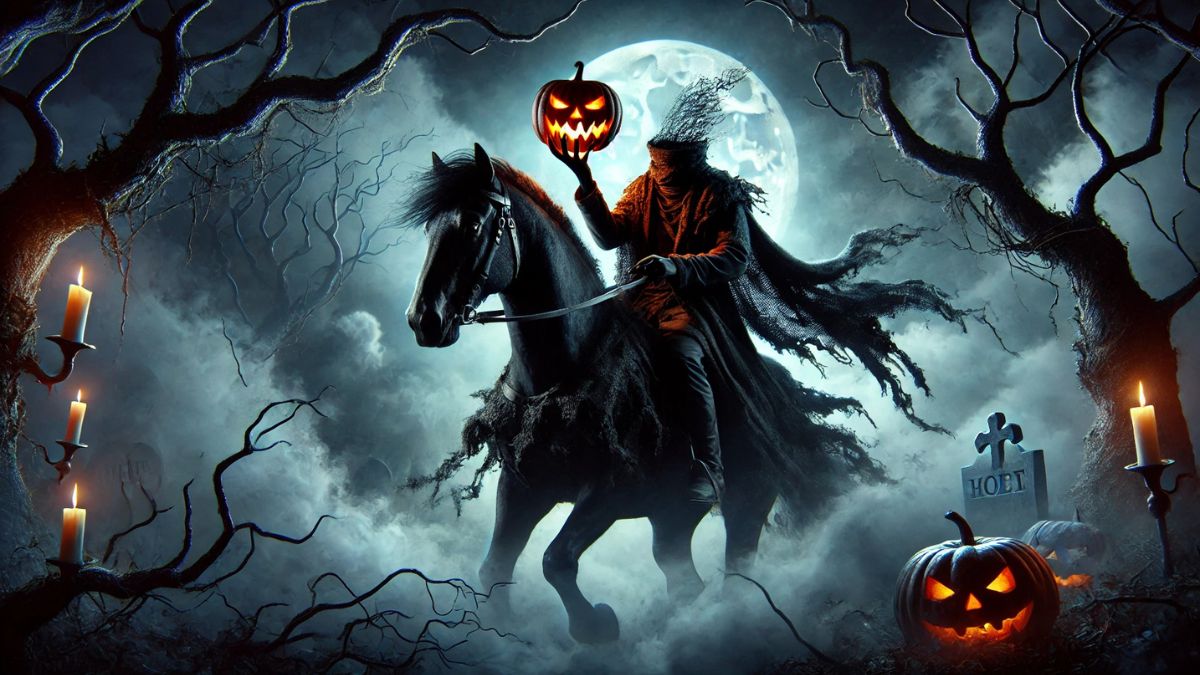
There’s a sound you never want to hear on a dark Irish road at night. Hoofbeats. Coming fast. And then, if you’re unlucky enough to catch a glimpse, you’d see it: a figure on horseback, cloaked in shadow, holding its own severed head aloft like a lantern. The Dullahan doesn’t knock. It doesn’t warn you. It just arrives, speaks your name once, and that’s it. Your time is up.
So, what exactly is the Dullahan? Simply put, it’s one of the most fearsome figures in Irish mythology, a headless supernatural being, usually on horseback, that acts as a harbinger of death. Wherever the Dullahan stops, someone nearby dies. No walls, no gates, and no locks can keep it out. If it calls your name, you’re already gone.
It sounds like pure nightmare fuel, and honestly, it is. But there’s a lot more to this creature than just its shock value. The Dullahan is deeply rooted in Irish folklore, connected to ancient beliefs about death, the Otherworld, and the thin boundary between the living and the dead. Let’s dig into what makes this being so fascinating and so enduring.
Where the Dullahan comes from

Ancient roots in Celtic belief
The Dullahan’s origins are tangled up in some of Ireland’s oldest spiritual traditions. Many folklore scholars connect it to Crom Dubh, a dark harvest deity who was once worshipped in pre-Christian Ireland and to whom, according to some accounts, human sacrifice may have been made. When Christianity arrived, and the old gods were pushed out of the official religion, they didn’t simply vanish. They got demoted. Many became the fairy beings, or “Aos Sí,” of later Irish tradition, and some believe the Dullahan is one of those fallen figures, stripped of its divine status but not its power.
This connection to the Tuatha Dé Danann, the mythological race of supernatural beings in Irish legend, is worth noting. As those divine figures faded from official worship, they didn’t disappear. They transformed. The Dullahan may be one of the darker remnants of that transformation, carrying death in a way that older gods once presided over the harvest, whether of crops or souls.
A creature of Samhain
The Dullahan is most active around Samhain, the Celtic festival that marked the end of the harvest season and the beginning of the dark half of the year (roughly what we now call Halloween). During Samhain, the veil between our world and the Otherworld was believed to be at its thinnest. Supernatural beings could cross over more easily, and death was very much in the air.
This timing isn’t coincidental. The Dullahan embodies Samhain’s core tension: life ending, darkness spreading, and forces beyond human understanding doing their work. It’s a psychopomp of sorts, a death escort, one that takes its job very, very seriously.
What does a Dullahan look like?
The head that sees everything
The most obvious feature is the missing head, which the Dullahan carries under one arm or holds up high. That head isn’t just a grim accessory. According to tradition, it glows with a dim, foul light, and its eyes can see across enormous distances, even in complete darkness. Nothing can hide from that gaze. If the Dullahan is searching for you, it will find you.
The face on the head is often described as rotten and decayed, the texture of mouldy cheese, with a grotesque grin spread from ear to ear. This isn’t the kind of thing you’d forget in a hurry.
The horse and the whip
The Dullahan typically rides a massive black horse, sometimes described as snorting fire, its mane streaming behind it as it gallops through the night. In some accounts, it doesn’t ride a horse at all but drives a black coach pulled by six black horses, a vehicle known as the “coach-a-bower” (from the Irish “cóiste bodhar,” meaning “deaf coach”). The wheels spark as they hit the ground. Gates and walls fly open as it passes, as if the world itself makes way.
In its hand, the Dullahan carries a whip made from a human spine. That detail alone tells you a lot about the kind of mythology we’re dealing with. This isn’t a spooky ghost story. It’s something far older and more visceral than that.
Gold: its one weakness
Here’s a detail that feels almost out of place, given how relentless the Dullahan is described as being. Gold is said to frighten it off. Even a small gold object, a coin, a pin, a piece of jewellery, can cause the Dullahan to retreat. Nobody seems to fully agree on why, but this weakness shows up consistently across different regional accounts of the legend, which suggests it has some real depth in the tradition.
What the Dullahan does (and why you should stay indoors)
The Dullahan’s job is simple and non-negotiable: it comes for the dying. When it stops its horse or coach outside a location and calls out a name, the person named dies immediately. There’s no appeal. There’s no mistake. It doesn’t get the wrong address.
In some versions of the legend, the Dullahan also throws a basin of blood on anyone foolish enough to be watching from a doorway or window. Not exactly the polite kind of supernatural visitor.
One thing that makes the Dullahan particularly unnerving compared to, say, a banshee (which also warns of death in Irish tradition) is that the banshee weeps and wails, giving a kind of grief-stricken warning. The Dullahan doesn’t warn you. It arrives after the decision has already been made somewhere else. It’s the delivery, not the diagnosis.
The Dullahan in Irish folklore tradition
Regional variations
Like most creatures in Irish folklore, the Dullahan isn’t a uniform myth. It varies depending on where in Ireland you’re collecting the story. In some counties, it’s mostly described as a solitary rider. In others, the coach version is more common. Some versions emphasise the blood-throwing. Others focus more on the impenetrability of the Dullahan’s purpose, the idea that no force on earth can stop it once it’s set its course.
Counties like Sligo, Roscommon, and parts of Galway are most frequently associated with Dullahan sightings in folklore collections, particularly those compiled during the Irish Folklore Commission’s great collection project in the 1930s. These were rural, agricultural communities where the line between the human world and the supernatural felt very thin.
Not to be confused with other dark figures
It’s worth distinguishing the Dullahan from some of its neighbours in Irish supernatural tradition. The banshee, for example, heralds death through sound and grief but doesn’t cause or carry out the death itself. The púca is another shape-shifting creature of Irish folklore that can take the form of a black horse, which sometimes creates confusion, but the púca is a trickster more than a death figure, often mischievous rather than murderous.
The Dullahan occupies a unique space. It’s not a ghost, not a demon in the Christian sense, and not quite a fairy in the playful way that word sometimes implies. It’s something older, more elemental, and specifically tied to the act of dying.
Why the Dullahan still resonates
The Dullahan has crossed over into modern pop culture in a surprisingly big way. It shows up in anime, fantasy novels, tabletop roleplaying games, and video games. The character Celty Sturluson in the anime “Durarara!!” is a Dullahan. Various fantasy games use it as a monster type. Writers keep coming back to it because the image is so arresting: the headless rider, the spine whip, the severed head that sees all.
But beyond pop culture, the Dullahan endures because it speaks to something real. Every culture has its death figures, its personifications of the moment when life ends. The Dullahan is Ireland’s version of that, and it’s a particularly uncompromising one. It doesn’t comfort. It doesn’t explain. It just comes, it calls your name, and it’s done.
There’s something honest about that, in a bleak sort of way.
Conclusion
The Dullahan is one of Irish folklore’s most vivid and enduring figures, a headless horseman who carries death itself across the dark countryside, unstoppable and indifferent. Its roots go back to pre-Christian Ireland, to old harvest gods and beliefs about the Otherworld that have never entirely faded from the Irish imagination.
Whether you encounter the Dullahan in an old folklore collection, a fantasy novel, or a late-night conversation about things that go bump in the dark, the creature holds a kind of power that purely invented monsters don’t quite manage. It grew out of real belief, real fear, and a real relationship with death that people in rural Ireland carried with them for centuries.
And if you ever find yourself on a lonely Irish road at night and hear hoofbeats coming fast? Maybe don’t look back. Just make sure you’re wearing something gold.
Frequently asked questions about the Dullahan
What is the difference between a Dullahan and a headless horseman?
The headless horseman is a broader archetype that appears in folklore traditions across Europe and North America, most famously in Washington Irving’s story “The Legend of Sleepy Hollow.” The Dullahan is specifically Irish in origin, with its own distinct mythology, characteristics, and purpose. Unlike Irving’s Hessian soldier, the Dullahan isn’t a ghost of a real person. It’s a supernatural being, possibly linked to ancient Celtic death deities, whose sole purpose is to collect the souls of the dying. The two figures share the striking image of a rider without a head, but their origins, meanings, and behaviours are quite different.
Are Dullahans female?
In traditional Irish folklore, the Dullahan is most commonly portrayed as male, typically depicted as a dark male figure on horseback or driving a coach. However, some accounts do describe a female version, occasionally referred to as a “Dullahan woman.” Irish supernatural tradition doesn’t rigidly enforce gender in the way some other traditions do, and regional variations exist. Modern retellings, particularly in anime and fantasy fiction, have popularised female Dullahan characters, most notably Celty from “Durarara!!” This is a creative interpretation rather than strict folklore, but it’s not entirely without precedent in the broader tradition either.
What does a Dullahan do?
The Dullahan’s function is specific: it travels to wherever someone is about to die, stops outside, speaks the dying person’s name aloud, and that person dies. It’s essentially a supernatural death escort. Along the way, it may throw a bowl of blood at bystanders who dare to watch. No lock, gate, or barrier can stop it from reaching its destination. Its severed head, carried in its hand, can see across vast distances in total darkness. Gold is the one thing said to frighten it away, though it’s unclear from the folklore tradition whether gold can actually prevent a death or simply delay the Dullahan’s appearance.
Are Dullahans fey or undead?
This is a question that folklore tradition doesn’t answer neatly, and it gets debated quite a bit in modern fantasy communities. In Irish tradition, the Dullahan exists within the category of “Aos Sí,” the supernatural beings associated with the fairy mounds and the Otherworld. This puts it closer to the fey category in contemporary fantasy terms, though Irish fairies are very different from the gentle, winged creatures of Victorian fairy tales. It’s not considered undead in the traditional sense because it was never a living human being who died. It’s more ancient than that, possibly a remnant or transformation of an older deity. Most Irish folklore scholars would categorise it as a supernatural being of the Otherworld rather than the undead.
Is the Dullahan good or bad?
In straightforward terms, the Dullahan isn’t good, at least not from the perspective of anyone standing in its path. It causes death, or more precisely, it carries out death. But framing it as “evil” in the moral sense probably misses the point. In Irish tradition, the Dullahan isn’t malicious in the way a demon might be. It’s more like an elemental force, something that exists outside human categories of good and evil. Death comes for everyone. The Dullahan is simply the agent of that inevitability. You might as well ask if winter is bad. It’s just what it is. That said, if it’s heading toward you, that distinction probably feels pretty academic.


