
Every year on March 17, the world seems to collectively decide to wear green, pour pints of stout, and wave Irish flags with unmatched enthusiasm. Cities from Dublin to Sydney dye their rivers green. People who have never once set foot in Ireland suddenly discover a distant Irish ancestor. And somewhere, inevitably, someone is playing a tin whistle in a bar at noon.
But what is Saint Patrick’s Day, really? At its core, it is a Christian feast day held every year on March 17 to commemorate the death of Saint Patrick, the patron saint of Ireland, who is credited with bringing Christianity to the island in the fifth century. It has been observed in Ireland for over a thousand years. What started as a religious holiday has grown into one of the most widely celebrated cultural events on the planet, marked in over 170 countries.
Who was Saint Patrick? The man behind the myth
Here is the thing most people don’t know: Saint Patrick was not Irish. He was almost certainly Romano-British, born somewhere in what is now either Wales, Scotland, or northern England around 385 AD. His birth name was likely Maewyn Succat. “Patrick” came later.
At around the age of sixteen, Patrick was captured by Irish raiders and sold into slavery in Ireland. He spent roughly six years working as a shepherd, likely somewhere in the west of the country. It was during this time of isolation that he turned to Christianity, praying for hours each day.
Eventually, Patrick escaped. According to his own writings in the Confessio, he heard a voice telling him that a ship was ready for him. He walked roughly two hundred miles to a harbour, found passage, and made it back to his family.
But that is not the end of the story. He went back.
Why Saint Patrick returned to Ireland
After training as a priest and bishop, Patrick returned to Ireland as a missionary, driven by a vision he described as the Irish people calling him back. He spent the rest of his life travelling the island, baptising people, ordaining priests, and establishing the foundations of the Irish Christian church.
He died on March 17, 461 AD. Or thereabouts, the historical record is not exactly a spreadsheet. That date became his feast day, and over the centuries, it grew into the celebration we know today.
How Saint Patrick’s Day became a global celebration

The story of how a quiet Irish religious feast became one of the most recognised holidays on earth is really a story about emigration.
The Great Famine of the 1840s drove over a million Irish people out of Ireland in less than a decade. They scattered across North America, Australia, Argentina, and Britain. With them went their language, their music, their food, and their traditions, including March 17.
In the United States, the first recorded Saint Patrick’s Day parade took place in Boston in 1737. By the nineteenth century, the holiday had become a powerful symbol of Irish-American identity, a way for a marginalised immigrant community to say, proudly and loudly, “we are here, and we are not going anywhere.”
When I visited New York a few years ago and happened to be there on March 17, I was genuinely unprepared for the scale of it. Fifth Avenue was lined six deep with spectators. The sheer volume of people who showed up, many of them with no Irish ancestry whatsoever, was a reminder that this holiday has become something that transcends its origins. It is a celebration of Irish culture that the whole world has sort of adopted.
Saint Patrick’s Day in Ireland versus abroad
There is a meaningful difference between how Irish people celebrate the holiday at home and how it is celebrated elsewhere. In Ireland, particularly outside Dublin, it is still often a family day. There is a parade, usually through the town centre, followed by a meal together and maybe a session in a local pub. It is warm and communal rather than carnivalesque.
Dublin’s festival has grown into a multi-day arts and culture event, with street performances, music, and fireworks alongside the parade. But even there, locals will often tell you the best way to spend the day is to get out of the city centre and find a small-town parade instead.
On a trip to County Clare a few years back, I stumbled into the village of Kilfenora on March 17 entirely by accident. The parade consisted of maybe three tractors, the local school band, and a man in a leprechaun hat riding a bicycle. Everyone cheered anyway. It was one of the most genuinely Irish moments I have experienced.
Why is Saint Patrick’s Day so green?
The association with green was not always a given. The original colour associated with Saint Patrick was blue, specifically a shade called “Saint Patrick’s blue,” which still appears in some Irish heraldic imagery.
Green took over gradually, through a combination of factors:
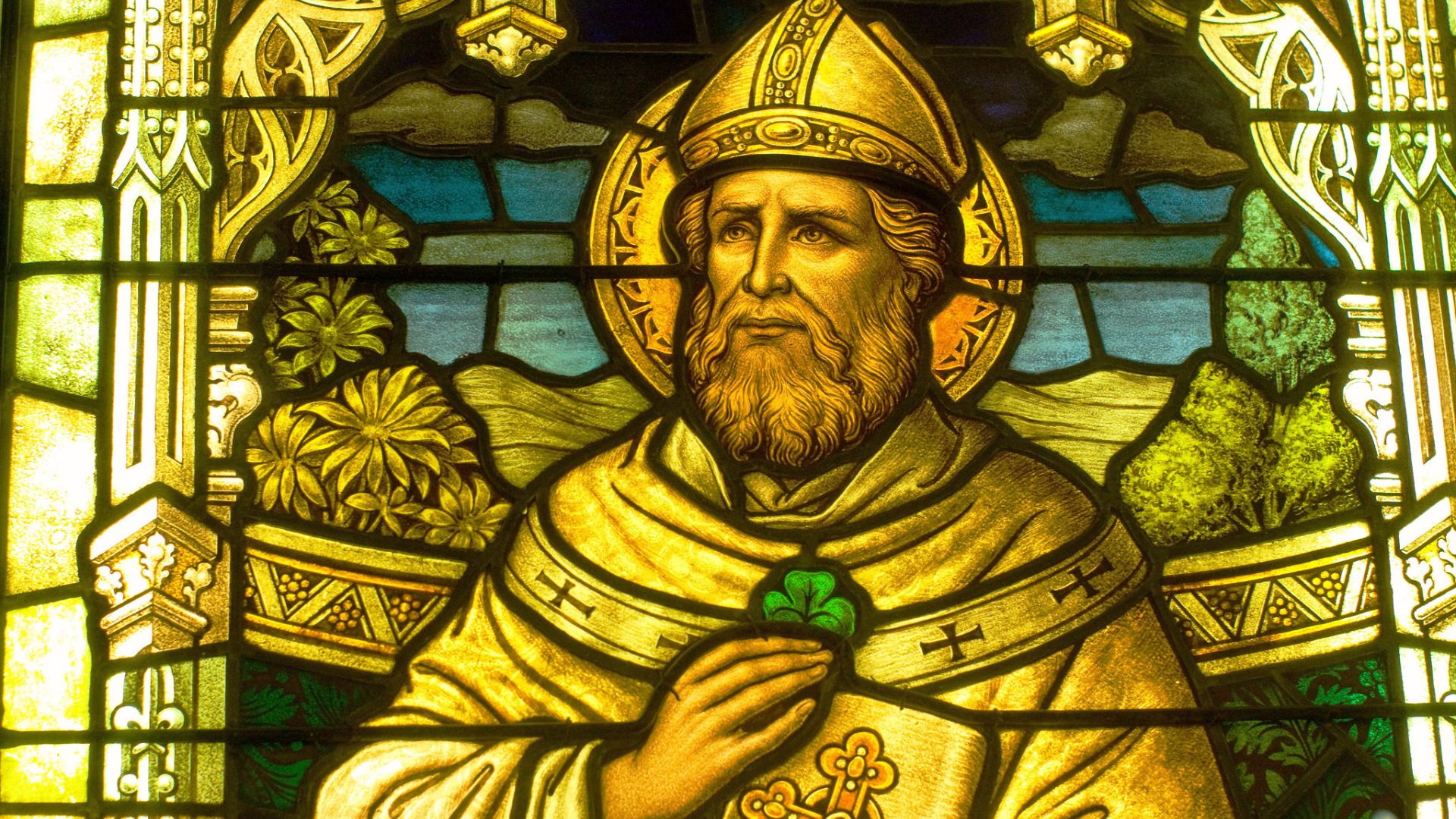
- The shamrock connection. Patrick’s use of the three-leafed plant as a symbol gave green an early association with Irish Christianity.
- Irish nationalism. By the late eighteenth century, green had become the colour of the United Irishmen, the republican movement that led the 1798 Rebellion. “The Wearing of the Green” was a rebel song of that era.
- The “Emerald Isle” imagery. Ireland’s lush, rain-soaked landscape made green a natural cultural identifier. The nickname “Emerald Isle” is centuries old.
- American pop culture. By the twentieth century, Irish-American celebrations had fully cemented green as the colour of the holiday, and Hollywood and advertising did the rest.
Today, global landmarks from the Colosseum in Rome to the Opera House in Sydney light up green on March 17 as part of Tourism Ireland’s global greening initiative, which launched in 2010.
Food, music, and the traditions worth knowing about
Saint Patrick’s Day in Ireland is not a food holiday the way Thanksgiving is in the United States. There is no single traditional meal, the way there might be with other celebrations. That said, a few things do show up consistently.
In Irish-American communities, corned beef and cabbage became the iconic March 17 meal, though this is much more of a diaspora tradition than an Irish one. In Ireland itself, you are more likely to see lamb stew, soda bread, colcannon, or a good bowl of chowder served in a pub. If you want to explore what Irish people actually eat on a celebration day, have a look at some of the Irish foods you must try on the blog.
Music is central. Traditional Irish music, specifically the session format where musicians gather informally to play reels, jigs, and ballads together, is at the heart of any good Saint Patrick’s Day in Ireland. You do not need to be a performer to participate. You sit, you listen, you buy the musicians a round, and you let the night take you somewhere.
Why do we celebrate Saint Patrick’s Day?
On the surface, we celebrate Saint Patrick’s Day to commemorate the life and death of the fifth-century missionary who shaped Irish Christianity. But the deeper answer is about identity, diaspora, and belonging.
For Irish communities abroad, especially those whose ancestors emigrated during times of hardship, March 17 became a way to hold onto something. A thread back to a place, a culture, a sense of shared story.
For Ireland itself, the holiday has become an extraordinary soft power moment. Tourism Ireland estimates that close to 13 million people worldwide claim Irish ancestry. On Saint Patrick’s Day, that network lights up. It is probably the most effective cultural marketing exercise any small country has ever pulled off, not through corporate strategy but through the genuine emotional weight of the Irish experience across generations.
And for everyone else? There is something about the spirit of the day that feels genuinely welcoming. Irish culture has a warmth to it, an emphasis on storytelling, music, conversation, and community, that invites people in. That is not an accident. It is baked into the culture.
Conclusion
Saint Patrick’s Day is many things at once. It is a religious feast day, a cultural carnival, a diaspora reunion, and a global moment of connection with Irish identity. The man at the centre of it all was a remarkable figure whose real story is far more compelling than the legends that grew up around him.
If March 17 means anything, it is that Irish culture, born on a small island on the western edge of Europe, somehow found its way into the hearts of people all over the world. That is worth celebrating, with or without the green beer.
Whether you are planning a trip to Ireland for the holiday, tracing your family roots, or just trying to understand the history behind the spectacle, I hope this has given you something worth knowing.