

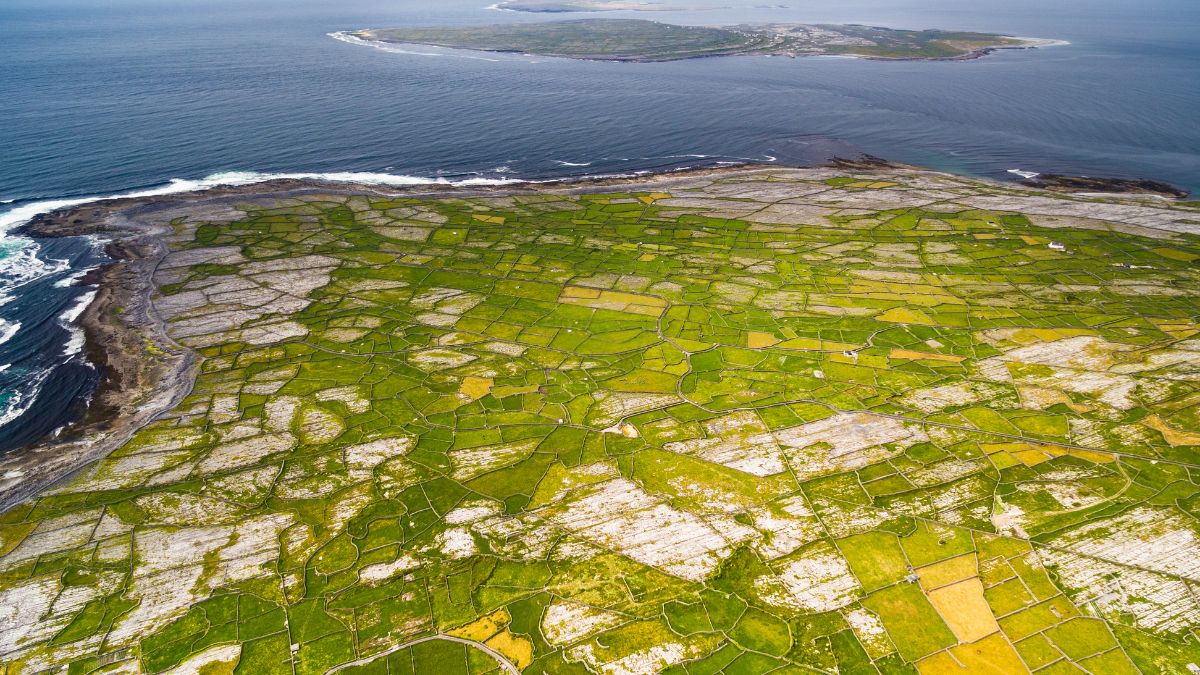
I still remember the first time someone described the Aran Islands to me as “Ireland with the volume turned down.” No traffic lights, no chain shops, just stone walls, wind, and the Atlantic doing its thing right at the edge of the road. That description has stuck with me through every hour I’ve spent researching these three islands, and it’s the closest thing to the truth I’ve found.
So here’s the deal. If you’re trying to figure out how to actually plan a trip to the Aran Islands, this guide covers it all: where they are, when to go, a bit of the history that makes them so different from the mainland, and a full breakdown of Inishmore, Inishmaan and Inisheer, including what to do, where to stay, where to eat, and how to get around each one. By the end, you should have everything you need to book your ferry and go.
Where are the Aran Islands?
The Aran Islands sit at the mouth of Galway Bay, off the west coast of Ireland, roughly where County Galway hands over to the wild stretch of the Atlantic. There are three of them:
- Inishmore (Inis Mór), the largest and busiest.
- Inishmaan (Inis Meáin), the quiet one in the middle.
- Inisheer (Inis Oírr), the smallest, closest to County Clare.
Geographically, they’re basically a continuation of the Burren, that grey limestone landscape you see around Clare. Geologically, it’s the same rock, just cut off by rising sea levels thousands of years ago. That’s why the islands feel so much like the Burren’s wilder cousin, all cracked limestone pavements and stone walls that seem to go on forever.
When to visit the Aran Islands
Most visitors come between May and September, and honestly, that’s the sensible choice if you want longer daylight, calmer ferry crossings, and every café and B&B actually open. July and August are the busiest months, especially on Inishmore, so book accommodation early if you’re travelling then.
If you don’t love crowds, aim for late April, May, or September. The weather is still decent, the islands are quieter, and you’ll get a much better shot at a table in the smaller restaurants without a wait.
Winter is a different animal entirely. Ferry schedules shrink, some guesthouses close for the season, and the Atlantic can turn genuinely rough. That said, if you want to see the islands stripped back to just wind, stone, and sea with barely another tourist in sight, there’s something honest about visiting in January. Just build flexibility into your plans in case a crossing gets cancelled.
History of the Aran Islands
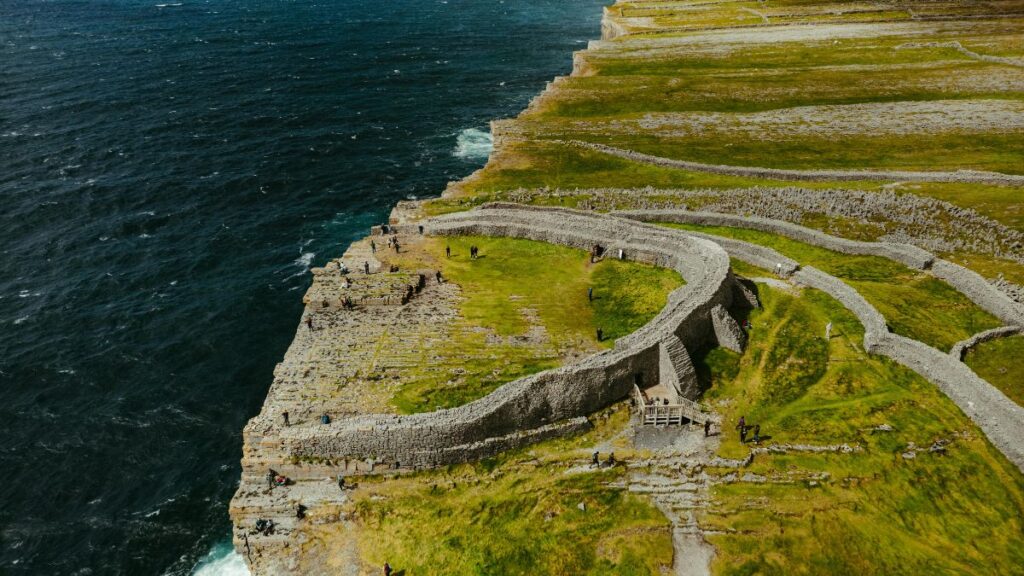
The Aran Islands have been inhabited for at least 4 000-years, and the evidence is still standing. Dún Aonghasa, the enormous stone fort perched on a cliff edge on Inishmore, dates back to the Bronze Age and was expanded through the Iron Age. Nobody knows for certain who built it or exactly why it sits so close to a sheer drop, which only adds to the pull of the place.
Early Christian monks arrived on the islands from around the 5th century, and their monastic ruins are scattered across all three, particularly around Cill Éinne on Inishmore. The islands became known as a place of learning and quiet devotion, sometimes referred to as “the Rome of Ireland” for how many saints reportedly studied and prayed there.
Fast forward a few centuries, and the Aran Islands became one of the last strongholds of the Irish language. They’re still a Gaeltacht region today, meaning Irish is the everyday language for a lot of islanders, not just something taught in school. The islands also gained an odd kind of fame in 1934 when the documentary-style film Man of Aran was released, showing island life, currach boats, and the endless work of building soil out of seaweed and sand on top of bare rock. That last part isn’t an exaggeration. Much of the islands’ farmland is literally handmade.
Inishmore (Inis Mór)
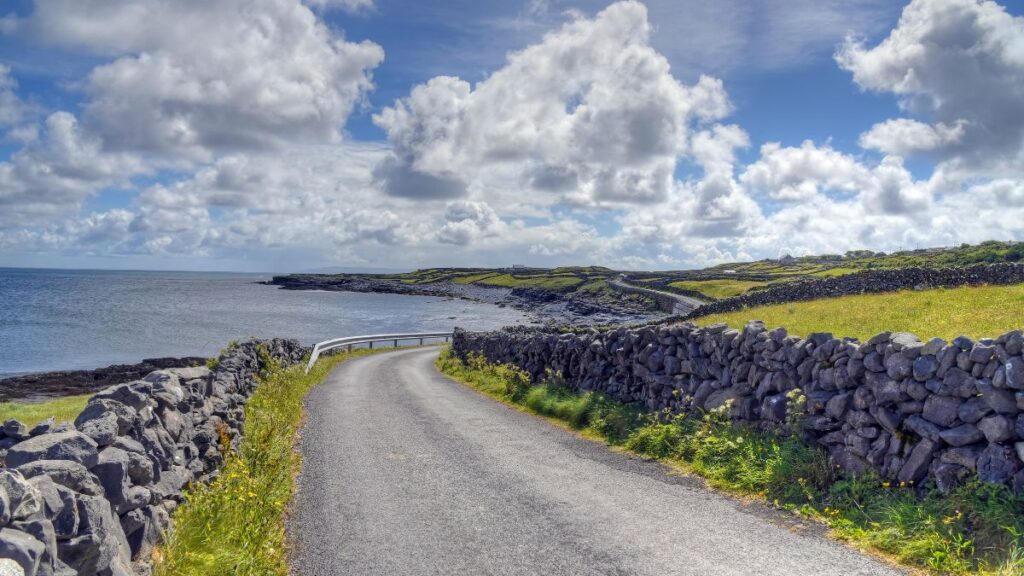
Inishmore is the biggest of the three islands, and the one most people mean when they say they’re “visiting the Aran Islands.” It’s home to Kilronan, the main village, and it’s where you’ll find the most infrastructure: shops, bike hire, restaurants, and the largest number of beds.
What to do on Inishmore
- Dún Aonghasa: The big one, and worth the walk up from the visitor centre. The fort’s outer wall sits right on a cliff edge with nothing but a 90-metre drop to the sea below.
- Seven Churches (Na Seacht dTeampaill): A cluster of early Christian ruins near the village of Eoghanacht, quieter than Dún Aonghasa and easy to have almost to yourself.
- Kilmurvey Beach: A genuinely lovely blue flag beach, good for a swim on a calm day even though the water is bracing.
- Cycle the coast road: This is honestly the best way to see Inishmore. Renting a bike in Kilronan and riding out toward Dún Aonghasa or the western cliffs takes you past stone walls, donkeys, and views you just can’t get from a bus window.
- The Wormhole (Poll na bPéist): A near-perfectly rectangular pool cut into the rocks by the sea, close to Dún Aonghasa. It looks almost too geometric to be natural, which is exactly why it’s become such a talking point among visitors.
- St. Benan’s Church (Teampall Bheanáin): Reputedly one of the smallest churches in the world, perched on a hill above Kilronan. It’s a short, steep climb, but the view over the harbour makes it worth the effort.
- Inishmore Seal Colony: A stretch of rocky shoreline near Kilmurvey where seals haul out to rest. Time your visit around low tide for the best chance of spotting them.
- Dún Dúchathair (Black Fort): A dramatic clifftop fort south of Kilronan, similar in style to Dún Aonghasa but far quieter, since most visitors don’t make the walk out to it.
- Inishmore Hiking Trail (Kilronan to Dún Aengus): A signposted walking route linking the village to the island’s best-known fort, taking you past smaller ruins and stone-walled fields along the way.
I once spoke with a bike hire owner in Kilronan who told me the same story every summer: visitors plan to spend two hours on the island and end up staying the whole day, simply because they didn’t expect how much ground there was to cover, or how often they’d want to stop just to look at something. That’s Inishmore in a nutshell. It rewards slow travel.
Accommodation on Inishmore
- Kilmurvey House: A Georgian farmhouse near the beach and close to Dún Aonghasa, well known for its breakfasts.
- Aran Islands Hotel: The island’s main hotel, in Kilronan, handy if you want to be near the ferry and the village.
- Pier House Guest House: A small guesthouse right in Kilronan, good for those who want to walk everywhere.
- Aran Islands Glamping: A good option if you want to sleep closer to the landscape without giving up creature comforts, with cosy pods set right on the island.
If you’re building a bigger Ireland itinerary around this trip and fancy pairing the wild simplicity of Inishmore with something a bit grander, it’s worth looking at some of Ireland’s castle hotels for the rest of your route. A night or two in a castle after a few days on stone and salt air is a nice contrast, and we’ve put together a full guide to the best castles to stay in Ireland if you want ideas.
Where to eat on Inishmore
- The Bar: A proper Kilronan pub with seafood chowder that locals actually recommend, not just tourists.
- Teach Nan Phaidi: A small tearoom near Kilmurvey Beach, ideal for a break after the walk up to Dún Aonghasa.
- Bayview Restaurant: A Kilronan spot known for solid, no-fuss meals and harbour views, a reliable choice after a long day of walking or cycling.
How to get around on Inishmore
Most people walk or cycle. Bike hire is available right at the pier in Kilronan, and it’s cheap, easy, and honestly the best way to see the island at your own pace. If cycling isn’t your thing, minibus tours run from Kilronan out to Dún Aonghasa and back, and pony traps are still an option for a slower, more traditional ride. A car isn’t necessary, and there’s nowhere to hire one on the island anyway.
Inishmaan (Inis Meáin)
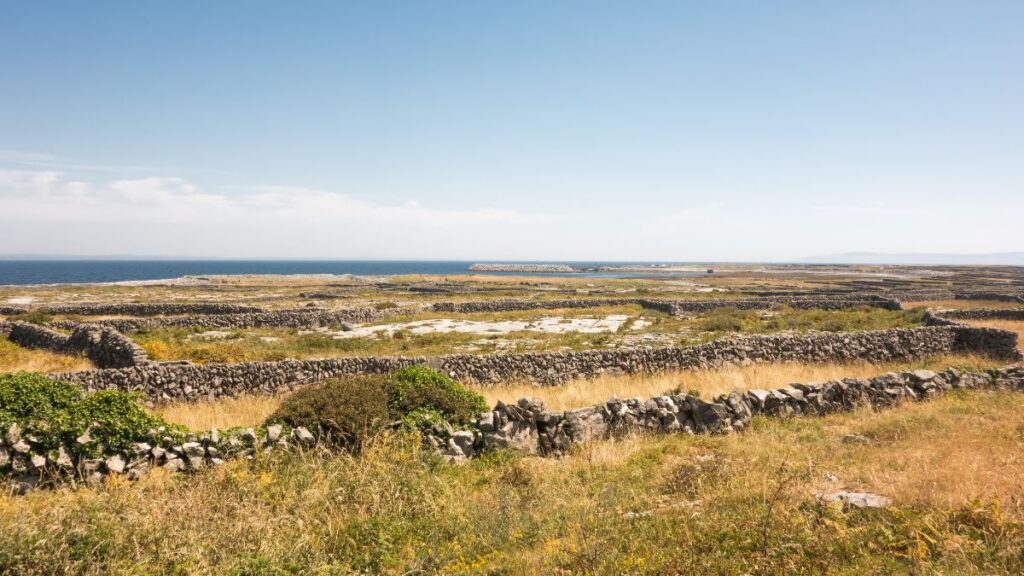
Inishmaan is the middle island, both in size and in personality. It gets a fraction of the visitors that Inishmore does, which is exactly why people who’ve been tend to love it the most. It’s quieter, more rugged, and still deeply tied to traditional island life.
What to do on Inishmaan
- Conor’s Fort (Dún Chonchúir): An oval-shaped stone fort on the island’s highest point, with sweeping views over the whole island. It’s the best spot to get your bearings before you set off walking.
- Ferbóy’s Fort (Dún Fearbhaí): A rectangular stone fort near the harbour, less visited than Dún Chonchúir and a good spot for a quiet look at Inishmaan’s ancient stonework.
- Synge’s Chair: A small stone shelter built into a cliff, named after the playwright J.M. Synge, who spent summers here and used the island as inspiration for his plays.
- Cnoc Raithní: A Bronze Age burial mound, one of several reminders that people have called this place home for millennia.
- Walk the boreens: Inishmaan doesn’t have a long list of attractions, and that’s kind of the point. Wandering the narrow lanes between stone walls, past traditional cottages, is the actual experience here.
- Inishmaan Hiking Trail (Lúb Cill Cheannannach): A looped walking route taking in the ruined early church at Cill Cheannannach along the coast, a good half-day option if you want to see more of the island beyond the main sites.
Accommodation on Inishmaan
- Inis Meáin Restaurant & Suites: A small, design-led set of suites attached to one of the best restaurants on any of the three islands.
- An Dún: A family-run bed and breakfast close to Conor’s Fort (Dún Chonchúir).
- Ard Alainn: A welcoming guesthouse known for its home-cooked breakfasts and warm hosts.
Where to eat on Inishmaan
- Inis Meáin Restaurant: The standout, focused on island-grown and locally caught ingredients, and genuinely one of the best meals you’ll have anywhere on the west coast.
- Teach Osta: The island’s traditional pub, good for a pint and a simple, honest meal.
How to get around on Inishmaan
Inishmaan is small enough to walk end to end in a couple of hours. There’s very limited bike hire, and most visitors just walk. There isn’t really a need for anything else. Roads are narrow and quiet, and the island’s whole appeal is in taking it slow on foot.
Inisheer (Inis Oírr)
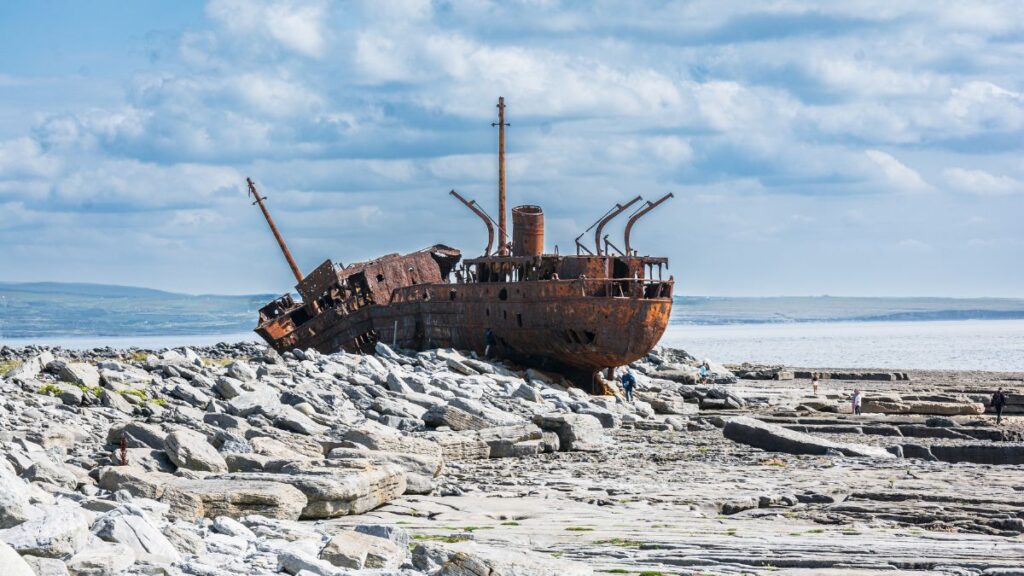
Inisheer is the smallest of the three and the closest to the mainland, just a short hop from Doolin in County Clare. It has a friendly, compact feel, and it’s easy to see most of it in a single day if that’s all the time you have.
What to do on Inisheer
- O’Brien’s Castle (Caisleán Uí Bhriain): A 14th-century tower house sitting on a hill above the village, with views out over the whole island.
- The Plassy shipwreck: The rusted hull of a cargo ship that ran aground in 1960, now sitting on the rocks near the beach, famous for appearing in the opening credits of Father Ted.
- Tobar Éinne (St Enda’s Well): A small holy well that’s part of a walking route around the island’s early Christian sites.
- Lace and knitwear shopping: Inisheer has a strong tradition of hand-knitting, and you’ll find genuine Aran sweaters here rather than mass-produced versions.
- Teampall Chaomháin: A partially sand-covered early church near the airstrip, dedicated to the island’s patron saint. It’s dug out by hand each year to keep it from disappearing under the dunes entirely.
- An Trá: The island’s main beach, a wide stretch of sand right by the harbour, good for a walk or a swim if the weather’s playing along.
- The lighthouse: A working lighthouse on the island’s eastern edge, a good target for an easy walk with views back toward the Clare coast.
- Inisheer Hiking Trail (Lúb Ceathrú an Locha): A looped walking route past the lake and through the island’s quieter back roads, a nice way to see a side of Inisheer most day-trippers miss.
A friend who visited Inisheer told me she’d planned to stay for the afternoon and catch the last ferry back to Doolin, but she missed it on purpose after finding the shipwreck walk and realising there was a small guesthouse room free for the night. She said watching the sunset over the Plassy wreck alone was worth rearranging her whole trip for. I think about that story every time someone asks whether one day on Inisheer is enough.
Accommodation on Inisheer
- Óstán Inis Oírr (Hotel Inisheer): The island’s main hotel, close to the pier and the village centre.
- Radharc An Chláir: A bed and breakfast with views across to the Clare coastline.
- South Aran House: A small, welcoming guesthouse known for its food and hospitality.
- Bru Radharc na Mara: A hostel option for budget travellers, close to the beach.
Where to eat on Inisheer
- Fisherman’s Cottage: A cosy spot known for fresh seafood and homemade desserts.
- Tigh Ruairí: The island’s pub, good for a relaxed pint and pub food after a day of walking.
- Óstán Inis Oírr restaurant: Convenient if you’re staying at the hotel, with solid, unfussy meals.
How to get around on Inisheer
Given how small Inisheer is, walking covers most of it easily. Bike hire is available near the pier if you’d rather cycle, and pony and trap rides are still offered for those who want a more traditional tour. As with the other islands, there’s no need for a car here.
Conclusion
The Aran Islands aren’t the kind of place you rush. Each island has its own rhythm: Inishmore is busier and more built up, Inishmaan wonderfully quiet, Inisheer small enough to feel like a secret even though it’s the easiest to reach. Whichever one you choose, or if you manage all three, you’ll come away with a much better sense of what Ireland looked like before motorways and shopping centres ever existed. Bring good shoes, a raincoat regardless of the season, and give yourself more time than you think you need. The islands have a way of slowing you down whether you plan for it or not.
FAQs about the Aran Islands
How much time do you need for the Aran Islands?
A day trip to Inishmore is doable and common, but you’ll only really scratch the surface. Two to three days lets you see Inishmore properly and add a day trip to Inishmaan or Inisheer. A week gives you time to properly settle into island life on all three.
Which Aran Island is the best to visit?
It depends what you want. Inishmore has the most to do and the most infrastructure, so it suits first-time visitors. Inishmaan is best for those craving real quiet and traditional island life. Inisheer suits a shorter trip, since it’s small, easy to reach, and easy to see in a day.
How to travel around Aran Islands?
Bike hire, walking, minibus tours, and pony traps are the main options on each island. Ferries and small inter-island flights connect the three islands and to the mainland.
Do you need a car on the Aran Islands?
No. None of the three islands has car hire, and none of them needs it. Everything is close enough to walk or cycle, and locals get around the same way visitors do.
How long is the ferry from Ireland to Aran Islands?
From Doolin in County Clare, the crossing to Inisheer takes around 30 minutes. From Rossaveal in County Galway, the ferry to Inishmore takes around 40 minutes. Times to Inishmaan and Inisheer from Rossaveal are a little longer, and inter-island hops are quick, usually well under an hour.


