
There’s a stretch of road in Northern Ireland that makes you pull over every five minutes. Not because of traffic, but because you simply cannot believe what you’re looking at.
The Causeway Coastal Route is one of those drives that people describe in hushed, reverent tones. It has a way of doing that to you. One minute you’re winding through sleepy harbour villages, the next you’re standing at the edge of a cliff with the Atlantic slamming into black basalt columns below you. It’s dramatic, wild, and genuinely unlike anywhere else in the world.
So, what exactly is the Causeway Coastal Route? It’s a scenic driving route that stretches approximately 120 miles (193 km) along the northern coast of Northern Ireland, running from Belfast in the east to Derry (also known as Londonderry) in the northwest. The route is officially signposted and takes in some of the most jaw-dropping coastal scenery in Europe, including the Giant’s Causeway, Carrick-a-Rede Rope Bridge, the Dark Hedges, Dunluce Castle, and a string of charming coastal towns in between.
Whether you have two days or a full week, this guide will help you plan a trip you’ll still be talking about years later.
Where is the Causeway Coastal Route?
The Causeway Coastal Route runs along the northeastern coast of Northern Ireland, primarily through County Antrim. It hugs the North Channel, with Scotland visible on clear days just across the water.
The most popular direction is to drive from Belfast westward toward Derry, which means you’ll have the sea on your right for most of the journey. It’s a logical flow and lets you build up to the big landmarks gradually. That said, there’s no wrong direction. Some people prefer starting in Derry and ending in Belfast if they’re flying into one city and out of the other.
If you’re coming from the Republic of Ireland, you can easily connect to the route via Belfast, or approach it from the west through Derry. It’s also worth noting that you won’t need to worry about border crossings since Northern Ireland is part of the UK, though you will be crossing into a different currency zone (Sterling, not Euro).
And while you’re exploring the north, it’s worth knowing that just a short drive south along the west coast of Ireland takes you onto the Wild Atlantic Way, another epic coastal route that shares the same raw, windswept spirit as the Causeway Coast. Together, these two routes are arguably the most spectacular coastal road trip combination in all of Europe.
The best stops on the Causeway Coastal Route
You could drive the full Causeway Coastal Route in three or four hours without stopping. But doing that would be like buying a ticket to a concert and spending the whole night in the car park. The stops are the whole point.
Here’s where to make sure you get out of the car:
Giant’s Causeway
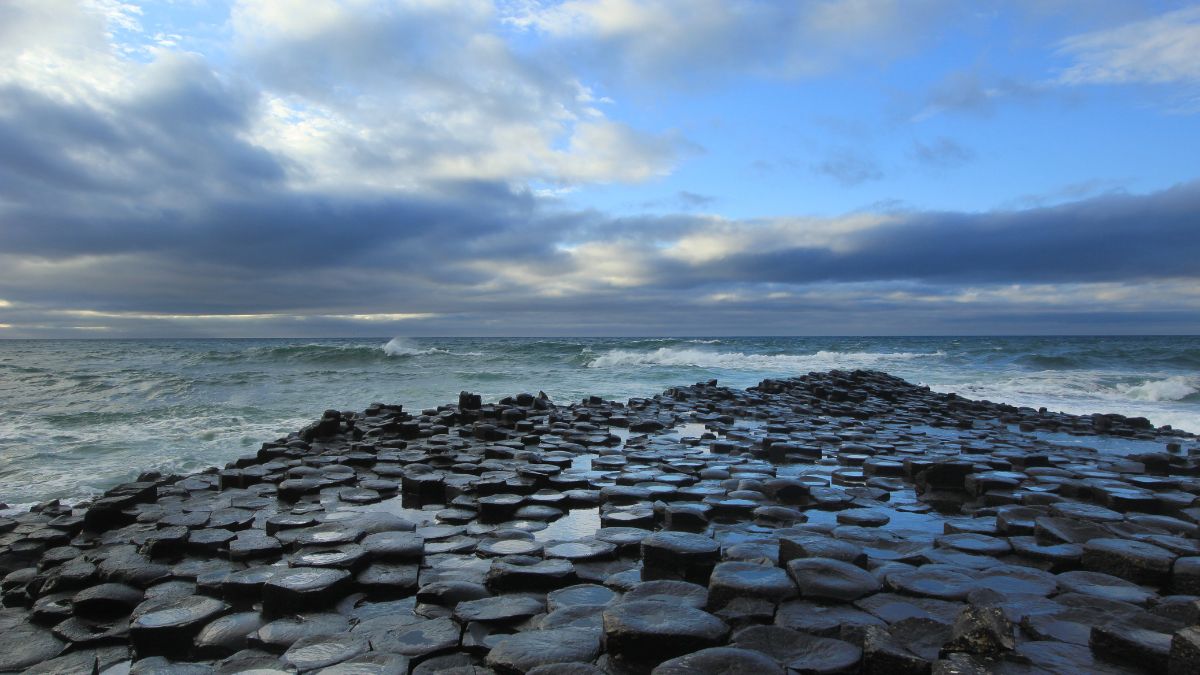
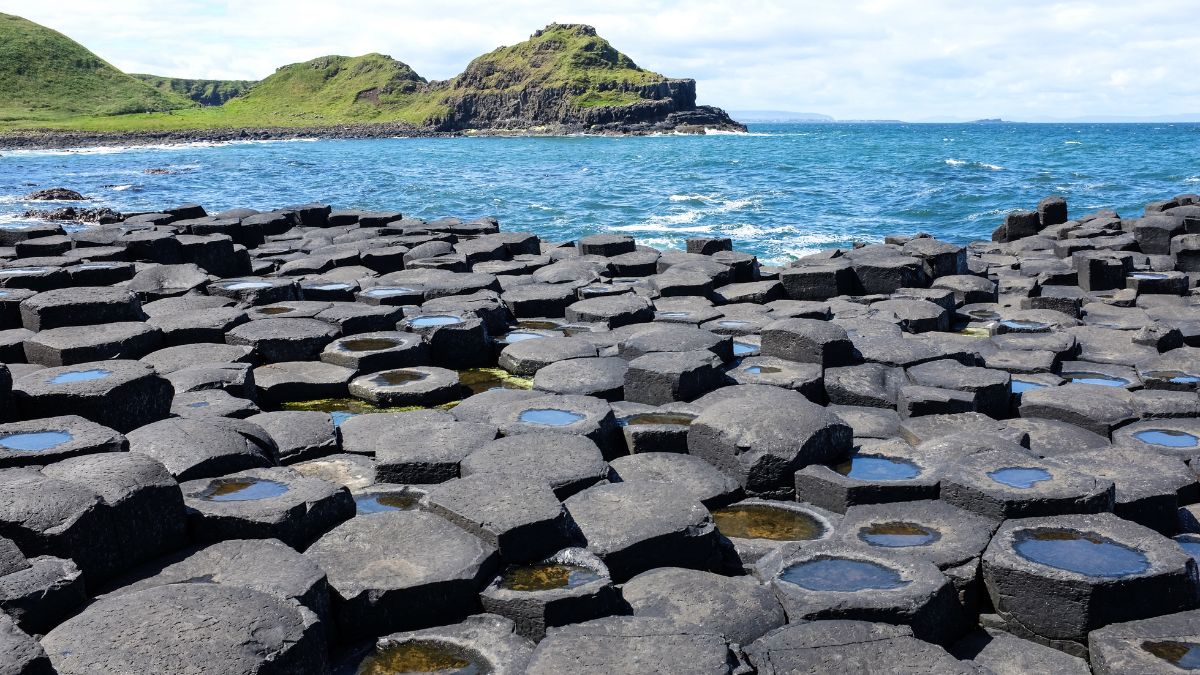
This is the one that puts Northern Ireland on every bucket list. Around 40,000 interlocking basalt columns, formed by ancient volcanic activity, step down from the cliffs into the sea like a giant’s staircase. (The legend says it was built by the Irish giant Finn McCool to walk across to Scotland for a fight. Draw your own conclusions.)
It’s a UNESCO World Heritage Site, and it earns that status. Go early in the morning if you can. Once the tour buses arrive mid-morning, the atmosphere shifts. But get there at 8 am on a misty day, and the place feels genuinely otherworldly.
The National Trust visitor centre has a good exhibition on the geology, which actually makes the whole thing more impressive once you understand how those perfect hexagonal columns formed.
Carrick-a-Rede Rope Bridge
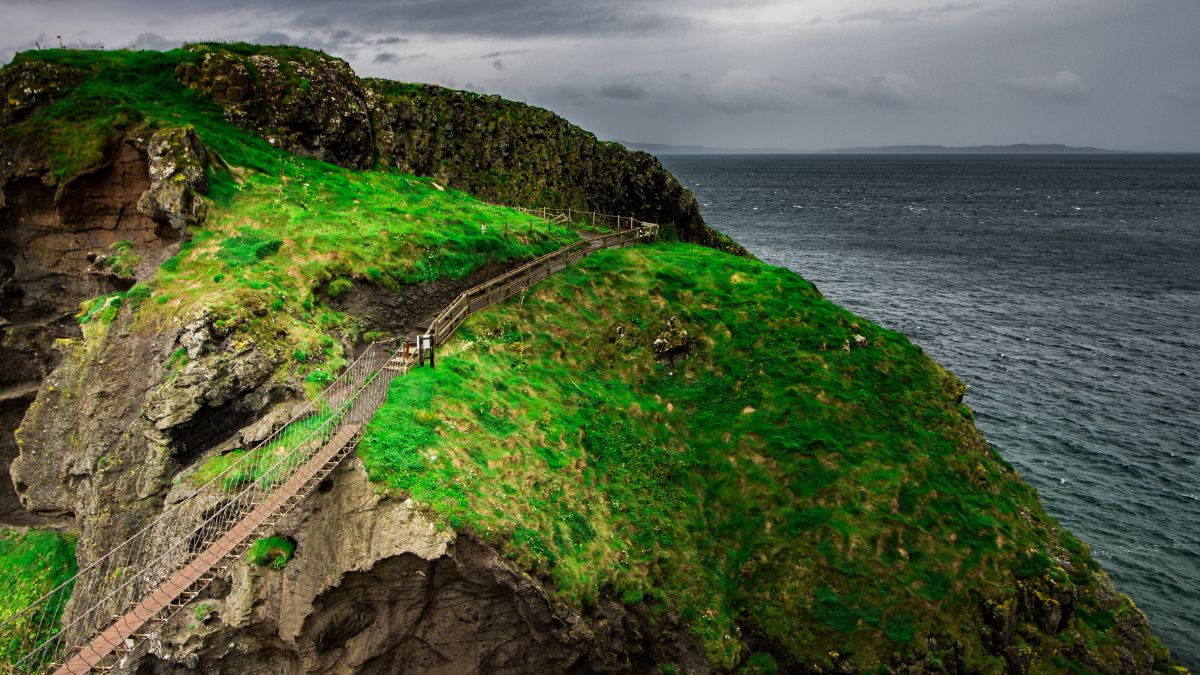
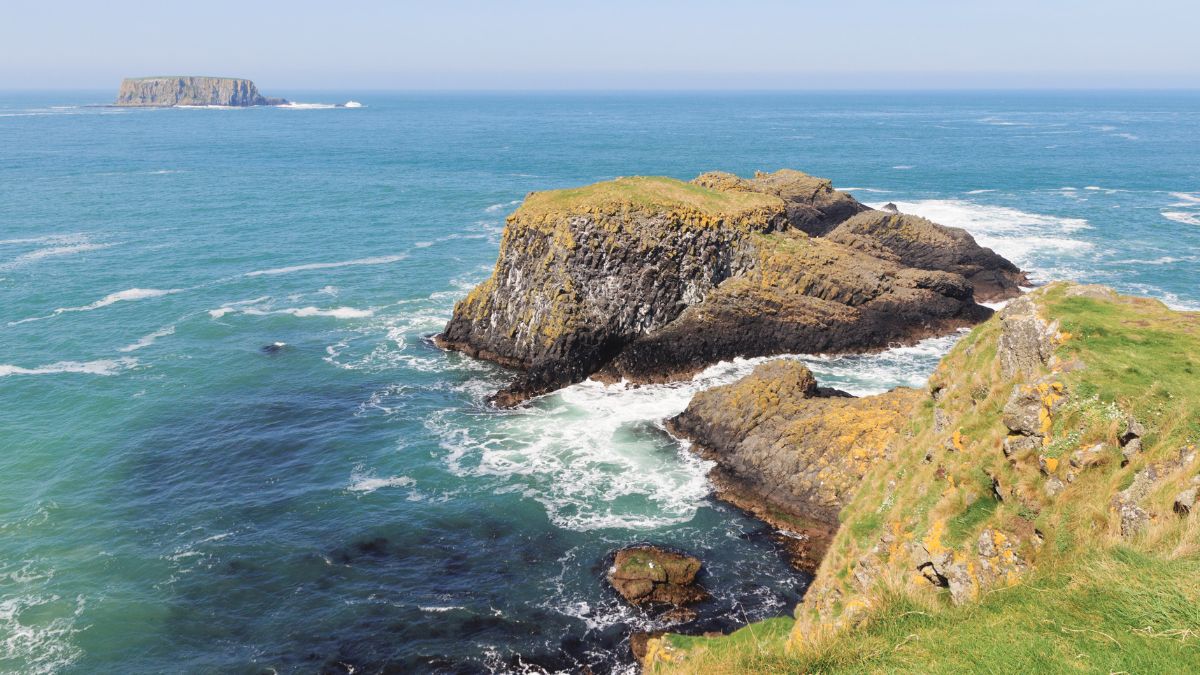
A thin rope bridge suspended 30 metres above the sea, connecting the mainland to a tiny island. It sways. The wind picks up. The sea churns below you.
It’s a short walk from the car park, but the experience stays with you. Salmon fishermen used to cross this bridge as part of their working day. Let that settle in for a moment.
Book your crossing in advance through the National Trust website, especially in summer. It sells out regularly.
Dunluce Castle
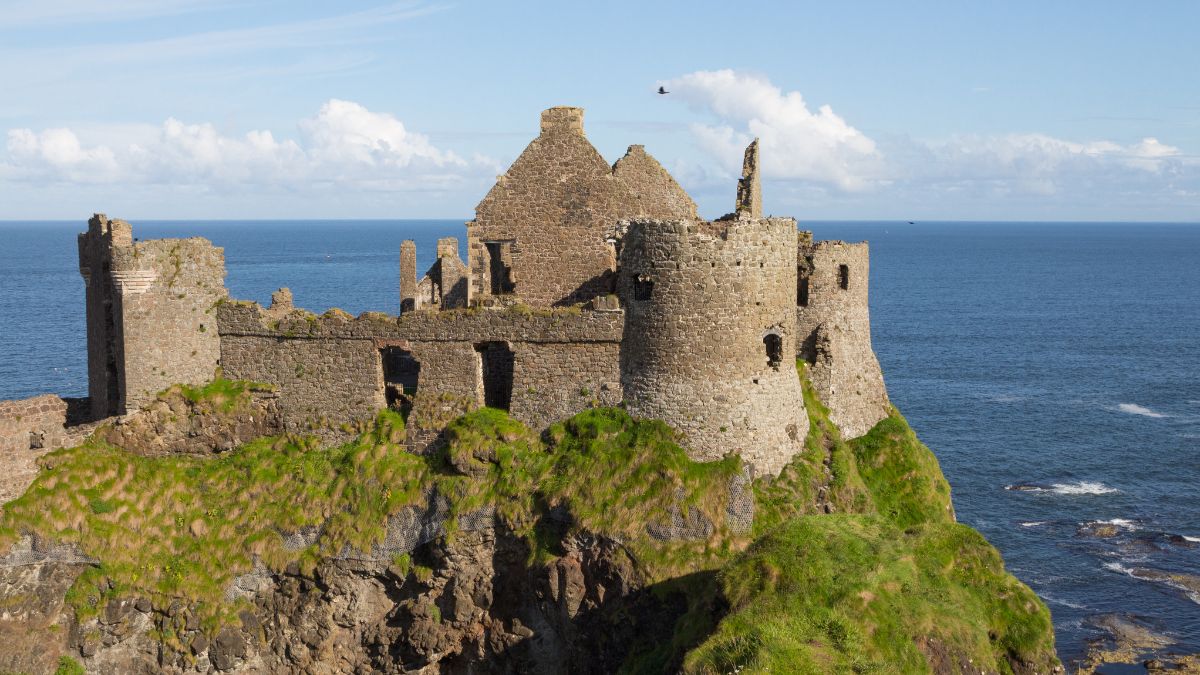
Perched on a clifftop so dramatic it looks computer-generated, Dunluce Castle is one of Ireland’s most photographed ruins. The medieval structure hangs over the edge of the Antrim Coast with the sea crashing below on three sides.
According to local legend, the castle kitchen once fell into the sea during a dinner party. Only the cook survived. Whether that’s true or not, it gives you a sense of just how precarious the whole thing is.
The Dark Hedges
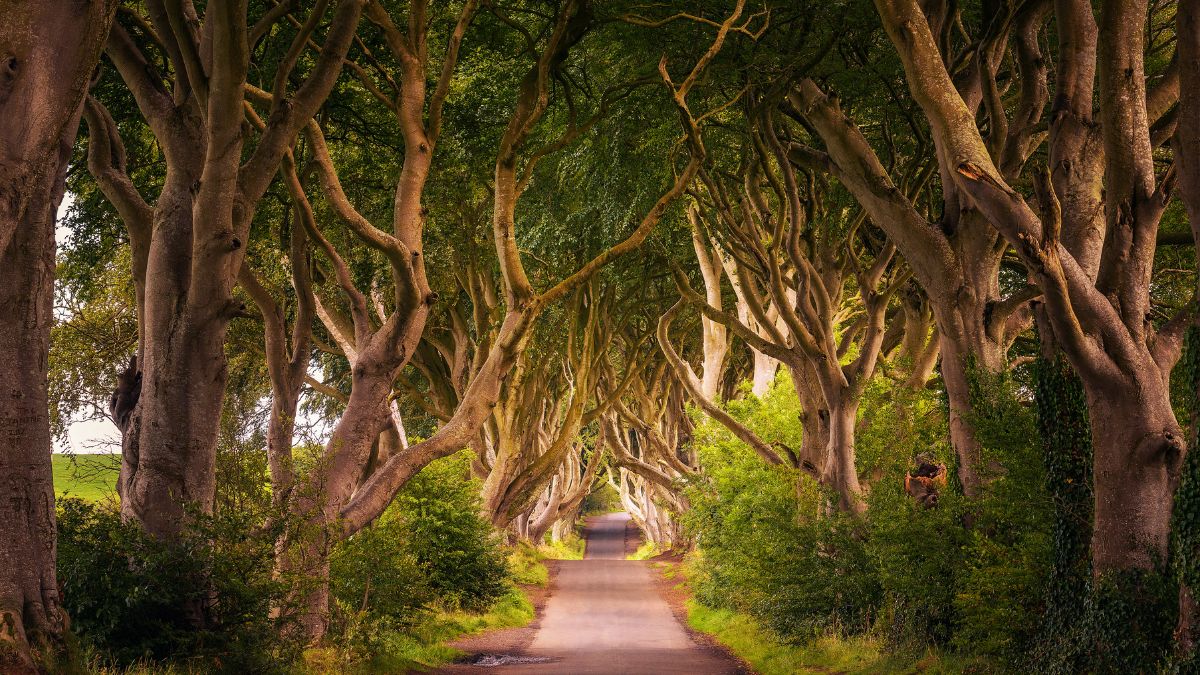
A tunnel of gnarled beech trees arching over a narrow country lane. It became famous as the King’s Road in Game of Thrones, but it was stunning long before HBO discovered it.
Go early morning or during the week if possible. It’s become very popular and can get busy. Still worth it.
Ballintoy Harbour
One of those places that stops you mid-drive. A tiny, perfectly formed harbour with whitewashed cottages and lobster pots. If you’ve seen Game of Thrones, it appeared as the Iron Islands. In real life, it’s just a quiet fishing village where you can grab a coffee and watch the sea.
Cushendall and Cushendun
These two villages in the Glens of Antrim are often overlooked in favour of the bigger landmarks, which makes them a treat. Cushendun is a National Trust village with distinctive white cottages, and Cushendall has great pubs and a relaxed local feel.
If you’re tired of tourist crowds by this point in the drive, these two will restore your faith in quiet discovery.
Portrush and Portstewart
Twin resort towns that bookend the western end of the Antrim coast. Portrush is livelier, with an amusement park vibe, great fish and chips, and easy access to Royal Portrush Golf Club (one of the world’s top links courses). Portstewart is slightly more genteel, with a beautiful strand that stretches for miles.
Both make good overnight bases.
Derry/Londonderry: the city at the end of the road

Most road trip guides treat Derry/Londonderry as a footnote. It shouldn’t be. If you’ve driven the full Causeway Coastal Route, this is where the journey ends, and it deserves at least a full day of your time.
First, the name. You’ll see it written both ways throughout Northern Ireland, and both are used depending on who you’re talking to. Derry is the name used by most locals and the Irish nationalist community; Londonderry is the official name and is used by many unionists. Visitors sometimes feel awkward about this. The easiest approach is to follow the lead of whoever you’re speaking to. Nobody expects tourists to get it right, and most people are relaxed about it. The city itself is often nicknamed “the Walled City,” which sidesteps the issue entirely.
Now, what to actually do there:
Walk the walls. Derry has one of the best-preserved sets of city walls in all of Europe, built in the early 17th century and still completely intact. You can walk the full circuit of the walls in around an hour. They’re free to access, and the views over the Bogside and down into the city are genuinely impressive. It’s one of those experiences where you don’t need a guidebook. Just walk and look.
Visit the Bogside. Just outside the city walls, the Bogside is the area that witnessed some of the most significant events of the Troubles, including Bloody Sunday in 1972. The famous murals painted on the gable walls of houses here tell that story with raw, unflinching honesty. There are 12 of them in total, collectively known as the People’s Gallery. No entry fee, no ticketing. You walk along the street and read the walls. It’s one of the most affecting public art installations you’ll find anywhere in Ireland.
Cross the Peace Bridge. Opened in 2011, this elegant curved footbridge connects the walled city on the west bank to the Ebrington area on the east bank. It’s a deliberate symbol of the connection between communities that spent decades divided. It’s also just a lovely walk, with good views back toward the city.
Spend time in the walled city itself. The streets inside the walls are compact and very walkable. Shipquay Street and Waterloo Place have a good mix of independent shops and cafes. The Tower Museum near the Diamond gives excellent context on the city’s history if you want more background on what you’ve been seeing. And the food scene has genuinely improved over the last decade: Pyke ‘N’ Pommes started as a street food cart and became something of a local institution, and there are several decent restaurants around Ferryquay Street worth trying.
A word on atmosphere. Derry has a reputation for being one of the friendliest cities in Ireland, and in my experience, that reputation is completely deserved. People will talk to you. They’ll give you directions before you’ve even asked. There’s a warmth to the place that you don’t always find in bigger, more tourism-saturated cities.
If you can, stay a night here rather than just passing through. The city feels different after the day-trippers leave.
How long does it take to drive the Causeway Coastal Route?
The route itself is about 120 miles. In pure driving time, you’re looking at three to four hours without stops. But nobody does it without stops, and you shouldn’t either.
Realistically:
- One day: You can cover the highlights (Giant’s Causeway, Carrick-a-Rede, Dark Hedges, Dunluce Castle) if you start early and keep things moving. It’ll be a full day and slightly rushed, but doable.
- Two days: This is the sweet spot for most visitors. A relaxed pace, time to explore, a night in Portrush or Ballycastle, and no feeling of racing from one car park to the next.
- Three or more days: You get to slow down, walk the coastal paths, visit the Glens of Antrim properly, and actually enjoy a meal at a decent pace.
My honest recommendation? Two nights, three days. Book accommodation in Ballycastle or Portrush and use them as your base. You’ll leave feeling like you actually experienced the place rather than just photographed it.
Do you need a car to travel the Causeway Coast?
This is a question that comes up a lot, and the honest answer is that a car makes everything significantly easier.
The Causeway Coastal Route is, at its heart, a driving route. The stops are spread out, public transport links between them are limited, and the most scenic stretches of road are on small country lanes where buses simply don’t go.
That said, it’s not impossible without a car:
- Translink operates the Causeway Rambler bus service (Route 252) during summer, connecting Coleraine, Bushmills, the Giant’s Causeway, Carrick-a-Rede, and Ballycastle. It’s a good option for a day trip to the main landmarks.
- Organised tours from Belfast are widely available and tend to cover the headline stops. Companies like McComb’s and Paddywagon run popular day trips.
- Cycling is increasingly popular along the route. The terrain is hilly in places, but the views more than compensate. E-bikes are available to hire in some towns.
If you’re coming from the Republic and don’t want to hire a car, a guided day tour from Belfast is probably your best option for seeing the major highlights.
Practical tips for driving the Causeway Coastal Route
Get an early start. The most popular stops get very busy by late morning, especially in July and August. Being at the Giant’s Causeway before 9 am is a genuinely different experience from arriving at midday.
Book ahead for Carrick-a-Rede. This sells out, particularly in peak season. Don’t assume you can just show up.
Download offline maps. Mobile signal is patchy in some of the more rural sections, particularly through the Glens.
Fill up in Ballymoney or Coleraine before heading onto the coast road. Petrol stations are sparse in some stretches.
Allow for weather. Northern Ireland’s weather is famously unpredictable. Pack a waterproof layer even in summer. A slightly dramatic cloudy sky over the Giant’s Causeway is honestly more atmospheric than full sunshine anyway.
Don’t skip the small things. The Bushmills Distillery is right on the route and does excellent tours. The Old Lammas Fair in Ballycastle (held every August) is one of Ireland’s oldest fairs. The harbour at Ballintoy is easy to miss if you’re not paying attention. These small detours are often the memories you keep.
A firsthand look: Two visitors, two very different experiences
Sarah’s story: A solo traveller from London
Sarah drove the Causeway Coastal Route solo over three days in October, hiring a small car from Belfast City Airport. She’d been once before on a group tour and felt she’d barely scratched the surface.
“The first time I did it, we stopped for twenty minutes at each place, and that was it,” she told me. “The second time, I sat on the rocks at the Giant’s Causeway for an hour and just watched the waves. I walked the whole clifftop trail. I found a tiny pub in Cushendall and had the best bowl of chowder I’ve ever eaten. It’s a completely different trip when you’re in charge of your own pace.”
She stayed in a guesthouse in Ballycastle that she’d found on a recommendation from a local shop owner, not a travel site. Total cost for three days, including accommodation, car hire, and food: just over £350.
Mark and his family: A road trip from Dublin
Mark drove up from Dublin with his partner and two kids, aged 8 and 11. They joined the Causeway Coastal Route at Larne and spent two nights in Portrush.
“We were nervous the kids would be bored,” he admits. “They weren’t. The rope bridge alone was 45 minutes of pure excitement. My son was terrified and wouldn’t admit it. My daughter wanted to cross it three times.”
The family also visited the Giant’s Causeway after 4 pm when the visitor centre crowds had thinned. “A ranger was still on duty and spent 20 minutes telling the kids about the mythology. That was the highlight for them, honestly. Better than any museum.”
Conclusion
The Causeway Coastal Route isn’t just a scenic drive. It’s a reminder that some of the world’s most extraordinary landscapes aren’t locked behind long-haul flights or expensive lodges. They’re right there, accessible, waiting for you to pull over and look properly.
If you’re heading to Ireland and you’re only going to the south, consider adding a loop through Northern Ireland. The contrast between the rugged Antrim coast and the green valleys of the glens is striking. The food scene in Belfast has genuinely matured. And the people are, without exception, worth talking to.
Whether you have a full week or just two days, the Causeway Coastal Route will give you more than you expect. It usually does.
FAQ: Your questions about the Causeway Coastal Route, answered
How long is the Causeway Coastal Route?
The Causeway Coastal Route is approximately 120 miles (193 km) long, running from Belfast in the east to Derry/Londonderry in the northwest. In terms of driving time without stops, you’re looking at roughly three to four hours. With stops at the main attractions, most people spread the journey over at least two days for a comfortable and enjoyable experience.
Where to stop on Causeway Coast?
The must-see stops include the Giant’s Causeway (a UNESCO World Heritage Site), Carrick-a-Rede Rope Bridge, Dunluce Castle, the Dark Hedges, Ballintoy Harbour, and the towns of Ballycastle and Portrush. If you have extra time, the Glens of Antrim villages of Cushendall and Cushendun are well worth the detour, along with a tour of the Old Bushmills Distillery.
Where is the Causeway Coastal Route?
The Causeway Coastal Route is located in Northern Ireland, along the northeastern and northern coastline of County Antrim. It runs between Belfast and Derry/Londonderry, with the North Channel (the stretch of sea between Northern Ireland and Scotland) as its constant companion to the north.
How long is the Causeway Walk?
The main walk at the Giant’s Causeway is approximately 2 km return, taking around 30-45 minutes at a gentle pace. If you include the clifftop trail for a more scenic loop, the full circuit is around 5-6 km and takes 1.5 to 2 hours. The terrain ranges from flat stone paths near the causeway itself to more uneven clifftop trails above it.
Can you travel the Causeway Coast without a car?
Yes, though it takes more planning. The Causeway Rambler bus (Route 252, operated by Translink) runs seasonally between Coleraine, Bushmills, the Giant’s Causeway, and Ballycastle. Organised day tours from Belfast are widely available and convenient for visitors without a vehicle. Cycling the route is also a popular option in summer, with e-bike hire available in some towns. That said, a hire car gives you by far the most flexibility and access to the smaller, less-visited spots along the way.