St. Kevin of Glendalough: Ireland’s hermit saint of the two lakes

Share this
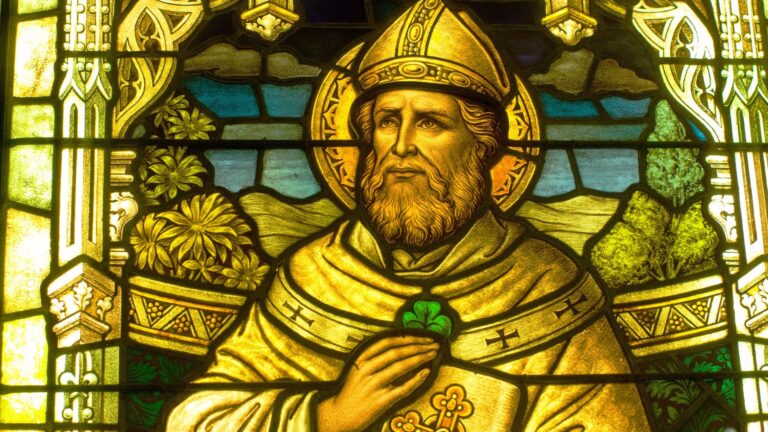
Picture a man standing so still, arms stretched out in prayer, that a blackbird mistook his hand for a branch and built her nest right there in his palm. He held that pose, so the story goes, until her eggs hatched and the chicks flew off on their own.
That’s the kind of saint St. Kevin was. Not a warrior. Not a politician in a bishop’s robes. Just a man who loved quiet, loved animals, and loved one particular Wicklow valley so much that he spent most of his life there.
If you’ve spent any time reading about Irish saints, you’ve probably noticed that St. Kevin comes up a lot, and for good reason. His story is one of the gentlest and strangest in Irish tradition, and it’s tied to one of the most beautiful places in the country. Let’s get into who he actually was.
Who was St. Kevin?
St. Kevin of Glendalough was a sixth-century Irish monk, born around 498 AD, who founded the monastic settlement of Glendalough in the Wicklow Mountains. He came from a noble Leinster family but walked away from that life to become a hermit, living alone in a cave above a lake for years before a community of followers grew up around him.
That community eventually became Glendalough, one of early Ireland’s great centres of learning, and it’s still standing today, tucked into a glacial valley about an hour south of Dublin. He died on the 3rd of June, 618 AD, and that date is still marked as his feast day across Ireland.
He’s not a saint most people outside Ireland have heard of. But if you’re Irish, or you have Irish roots, there’s a decent chance you’ve stood in Glendalough at some point without fully knowing whose valley you were standing in.
Growing up in noble Leinster
St. Kevin was born into a well-off family in Leinster, the ancient kingdom that covered much of what’s now the east of Ireland. Tradition names his parents as Coemlog and Coemell, and says he was born at a place called the Fort of the White Fountain.
He was sent to be educated by monks as a boy, which was fairly standard for children of his class at the time. What wasn’t standard was how seriously he took it. Most young nobles who studied with monks went on to ordinary lives, marriages, farms, maybe a bit of local politics. Kevin kept going. He was ordained a priest, and instead of settling into parish life, he headed for the hills.
Literally. He went to Glendalough.
Why St. Kevin chose a cave over a palace
Here’s the bit I find genuinely moving about this story. St. Kevin wasn’t running from anything. He wasn’t disgraced or exiled. He had options, a family name, an education, a future. He looked at all of that and chose a cave instead.
I remember the first time I came across the phrase used in his old Latin biography, that being buried at Glendalough was said to be as good as being buried in Rome. I’d been digging through translated excerpts of the Vita for background on this piece, half expecting dry medieval prose, and that one line stopped me. It tells you everything about how much this place came to mean, not just to him, but to everyone who came after him.
When he first arrived at Glendalough, St. Kevin wanted solitude, not followers. He settled into a small cave on a cliff face above the Upper Lake, a spot now known as St. Kevin’s Bed. It’s tiny. Realistically, an adult can’t stand up inside it. Some historians think it was originally a Bronze Age tomb, long before he ever set foot there.
Seven years in St. Kevin’s Bed
By most accounts, he lived like this for around seven years. He’s said to have:
- Worn rough clothing made from animal skins.
- Eaten very little, mostly herbs and whatever grew wild nearby.
- Spent long stretches of each day in prayer.
- Slept in a space barely big enough to lie down in.
It’s a hard life to picture from where we’re sitting. No electricity, obviously, but also no real comfort of any kind. Just cold stone, cold water, and his own thoughts. And yet this is the period people tend to romanticise most about him, because it’s when the animal stories start.
Building Glendalough: from hermitage to monastic city
Word gets around, even in the sixth century. People started seeking out St. Kevin, first for guidance, then to join him. What began as one man’s retreat slowly turned into a proper monastic settlement.
Glendalough grew into something remarkable. By the time it reached its peak, centuries after St. Kevin’s death, it had:
- A round tower still standing today, over 30 metres tall.
- Several stone churches, including St. Kevin’s Church, sometimes called “St. Kevin’s Kitchen”.
- A working scriptorium that produced illuminated manuscripts.
- A reputation as one of the chief pilgrimage destinations in medieval Ireland.
St. Kevin himself reportedly made a pilgrimage to Rome and brought back relics for his growing community. He was also entrusted with raising the young son of a local king, which tells you how much trust he’d built by then, not bad for a man who’d started just wanting to be left alone.
The legends that made St. Kevin famous
This is the part most people actually come looking for. St. Kevin’s legends have a very particular flavour: Gentle, a little strange, and almost always involving animals.
The blackbird and the outstretched hand
The most famous one is the blackbird story I mentioned at the start. St. Kevin, deep in prayer with his arm out the window of his cell, stayed motionless long enough for a blackbird to nest in his palm. Rather than disturb her, he’s said to have held the position until her eggs hatched.
It’s such a good image that the poet Seamus Heaney wrote about it directly, and it’s easy to see why it’s stuck around for over a thousand years. It says something about patience, and about a kind of stillness most of us never manage.
The wolf, the doe, and a king’s son
A lesser-known but equally strange tale involves the infant son of a local king, sent to St. Kevin for fostering. With no cows in the glen for milk, St. Kevin is said to have commanded a wild doe to nurse the child. When a wolf killed the doe’s own fawn, St. Kevin supposedly told the wolf to take the fawn’s place at her side, so she’d keep giving milk.
Whether you take that literally or as a poetic way of saying he had an unusual gift for keeping peace between wild things, it fits the pattern. Every story about him circles back to the same idea: this was a man animals trusted.
A saint known for keeping the peace
There are other, smaller stories too. One tells of a wild boar fleeing hunters that ran straight to where St. Kevin was praying, and the hunting dogs simply stopped in their tracks rather than go near him. Another darker tradition, tied to a woman who reportedly pursued him, is less flattering and far less certain, and most historians treat it as a later embellishment rather than fact. His story, taken as a whole, is really a story about someone who found more peace with nature than most of us manage with other people.
St. Kevin’s legacy, centuries on
St. Kevin was never formally canonised in the modern sense, though Pope Leo XIII confirmed his veneration in 1902 and added him to the universal liturgical calendar. That’s a small technicality in the bigger picture. Locally, he had been treated as a saint for well over a thousand years by that point.
Glendalough outlived him by centuries as a centre of learning, until it was eventually absorbed into the Diocese of Dublin. Today the ruins sit inside the national parks in Ireland system, specifically within Wicklow Mountains National Park, which tells you something about how the landscape and the legend have become inseparable. You can’t really talk about one without the other.
Visiting Glendalough today

If you ever get the chance to go, Glendalough is one of those rare sites where the history doesn’t feel roped off behind glass. You can walk the same ground St. Kevin walked, past the round tower, through the old graveyard, along the shore of the Upper Lake toward the cliff where his cave still sits.
A few practical things worth knowing:
- The monastic site itself is free to enter and open year-round.
- There are trails ranging from an easy lakeside stroll to a more demanding 11km loop.
- The visitor centre has a small interpretive exhibit worth doing first, before you wander the ruins.
- St. Kevin’s Bed is visible from the north shore of the Upper Lake, though it’s not something you can climb into.
I always tell readers planning a Wicklow trip to give themselves more time here than they think they’ll need. It’s not a fifteen-minute photo stop. It’s a valley you sit with for a while.
One of our readers once sent in a photo from a family trip to Glendalough, and mentioned that her grandfather’s people had come from that stretch of Wicklow generations back. She said walking the site felt less like sightseeing and more like checking in on somewhere that was already, in some small way, hers. I think about that a lot when I write these pieces. St. Kevin’s valley has a way of pulling people back, even people who’ve never set foot there before.
Conclusion
St. Kevin of Glendalough isn’t a flashy saint. He didn’t slay dragons or convert kingdoms overnight. What he did was quieter and, in its own way, harder: he chose solitude over comfort, built something lasting out of that choice, and left behind a valley that still draws people in more than fourteen hundred years later.
Whether you come to Glendalough for the history, the hiking, or the strange comfort of a story about a saint and a blackbird, St. Kevin’s legacy is easy to find once you know where to look. It’s written into the round tower, the old stone churches, and every quiet corner of that Wicklow glen.
What is St. Kevin the patron saint of?
St. Kevin is recognised as one of the patron saints of the Archdiocese of Dublin, along with Glendalough itself. He’s also informally associated with blackbirds, thanks to his famous legend, and is tied to the parish of Kilnamanagh, where he studied as a young man.
What miracles did St. Kevin do?
The most well-known is the blackbird nesting in his outstretched hand while he prayed. Other traditional stories credit him with commanding a wild doe to nurse an orphaned infant, calming a wolf so it wouldn’t harm the doe, and causing hunting dogs to stop dead rather than approach him while he prayed near a fleeing boar. Most of these come from a Latin biography written centuries after his death, so they’re best understood as tradition rather than verified fact.
What did St. Kevin do at Glendalough?
He founded it. St. Kevin first lived there alone as a hermit, spending years in a small cave known as St. Kevin’s Bed above the Upper Lake. As followers gathered around him, that hermitage grew into a full monastic settlement, complete with churches and a round tower, which went on to become one of medieval Ireland’s most important centres of learning and pilgrimage.
Where is St. Kevin buried?
St. Kevin is traditionally believed to be buried within the monastic site at Glendalough, County Wicklow. Local tradition points specifically to Reefert Church, whose name is thought to derive from words meaning burial place of kings, as the original site of his tomb, though no single marked grave has been definitively confirmed.
What does the name Kevin mean in Irish?
The name comes from the old Irish Cóemgen, modernised as Caoimhín, and is generally translated as “fair begotten” or “of noble birth.” Some sources render it more loosely as “handsome” or “comely,” but the core meaning ties back to noble or gentle birth, which fits neatly with St. Kevin’s own background.